Using Terraform Modules to Standardize and Accelerate Cloud Infrastructure Deployment
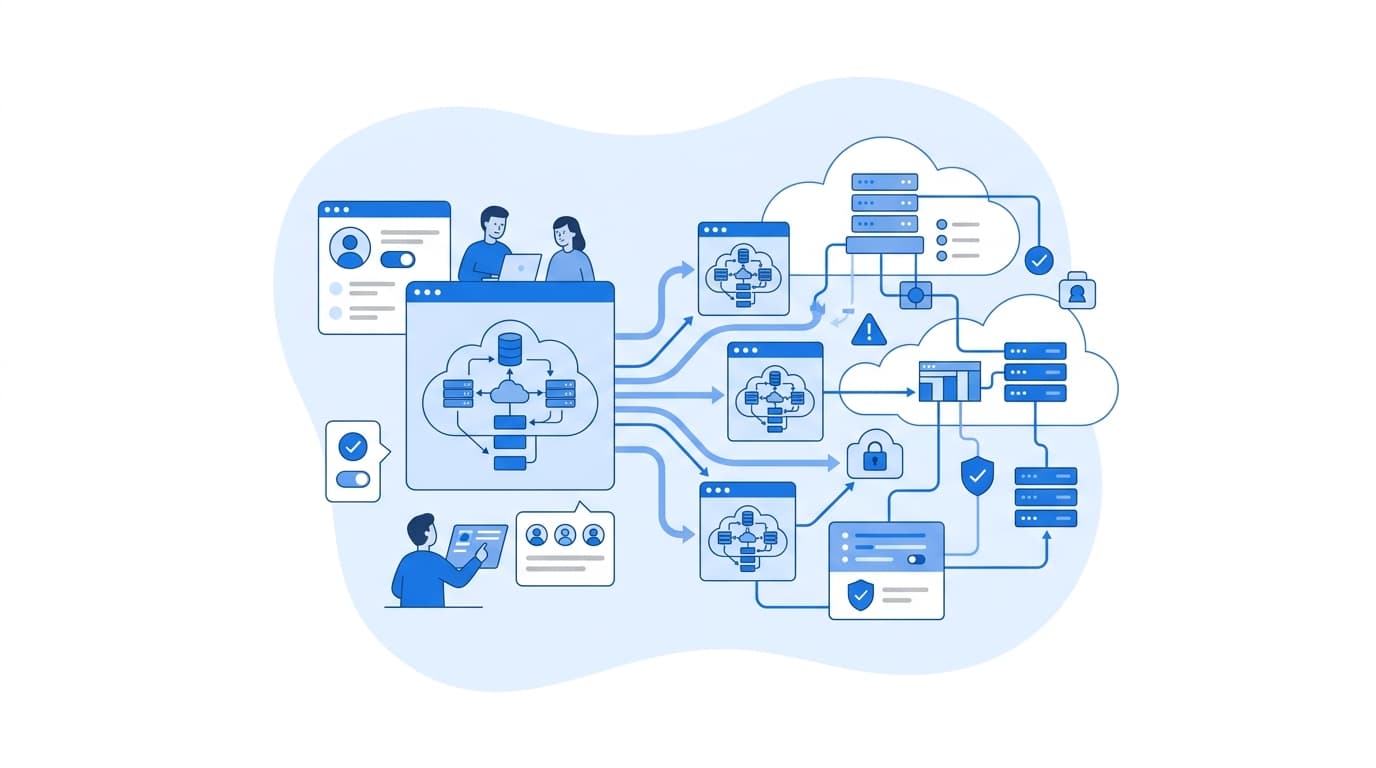
Terraform modules standardize and accelerate cloud infrastructure deployment by packaging a proven pattern (a VPC, a storage bucket, a Kubernetes node pool) behind a small, versioned interface that every team consumes instead of rewriting. The approach that works is to draw module boundaries around things teams deploy together, keep inputs narrow and opinionated, enforce guardrails with validation, version every release, and test modules before they reach consumers. Done well, a new environment becomes a short composition of trusted building blocks rather than hundreds of lines of copied resource definitions.
This guide walks through how we approach each of those steps, with code you can adapt.
Why Copy-Paste Infrastructure Breaks Down
Most organizations do not set out to build inconsistent infrastructure. It happens gradually. One team writes a working S3 bucket configuration, another team copies it, a third copies the second team's copy and drops the encryption block because it caused a plan error. Six months later, nobody can say with confidence which buckets enforce encryption, which have public access blocked, or which follow the tagging policy finance needs for cost allocation.
The symptoms are familiar:
- Drift between environments. Staging and production diverge in small ways that surface only during incidents.
- Slow reviews. Every pull request contains hundreds of lines of raw resources, so reviewers skim instead of scrutinize.
- Security fixes that never finish. A hardening change must be applied in dozens of places, and some are always missed.
- Onboarding friction. New engineers must learn every provider nuance before they can ship anything safely.
Modules address the root cause: the knowledge of how to build something correctly lives in one place, and everyone else consumes it.
Designing Terraform Modules That Teams Actually Reuse
A module that nobody adopts standardizes nothing. Reuse depends far more on design decisions than on tooling.
Pick the right boundary
A common mistake is wrapping a single resource in a module that exposes every argument of that resource. That adds indirection without adding value. The opposite mistake is a "platform" module that provisions an entire environment and becomes impossible to change safely.
A useful test: a module should represent something a team would describe in one sentence and deploy as a unit. "An encrypted, private, tagged storage bucket" is a good module. "A service's network, database, cache, and DNS" is usually a composition of several modules, assembled in a root configuration.
HashiCorp's own guidance on module creation makes a similar point: avoid thin wrappers and build modules that raise the level of abstraction.
Design a narrow, opinionated interface
The interface is the product. Every variable you expose is a decision you are handing back to the consumer, and every decision is an opportunity for inconsistency. Expose what genuinely varies between use cases, and hard-code what your organization has already decided.
# modules/secure-bucket/variables.tf

variable "name" {
  description = "Logical bucket name. Prefixed with org and environment automatically."
  type        = string

  validation {
    condition     = can(regex("^[a-z0-9-]{3,40}$", var.name))
    error_message = "Name must be 3-40 characters: lowercase letters, digits, hyphens."
  }
}

variable "environment" {
  description = "Deployment environment."
  type        = string

  validation {
    condition     = contains(["dev", "staging", "prod"], var.environment)
    error_message = "Environment must be one of: dev, staging, prod."
  }
}

variable "versioning" {
  description = "Enable object versioning."
  type        = bool
  default     = true
}

variable "tags" {
  description = "Additional tags merged with required organizational tags."
  type        = map(string)
  default     = {}
}
Notice what is not a variable: encryption, public access settings, and the required tag set. Those are standards, so the module enforces them unconditionally.
# modules/secure-bucket/main.tf

locals {
  bucket_name = "acme-${var.environment}-${var.name}"
  tags = merge(var.tags, {
    environment = var.environment
    managed_by  = "terraform"
    module      = "secure-bucket"
  })
}

resource "aws_s3_bucket" "this" {
  bucket = local.bucket_name
  tags   = local.tags
}

resource "aws_s3_bucket_public_access_block" "this" {
  bucket                  = aws_s3_bucket.this.id
  block_public_acls       = true
  block_public_policy     = true
  ignore_public_acls      = true
  restrict_public_buckets = true
}

resource "aws_s3_bucket_server_side_encryption_configuration" "this" {
  bucket = aws_s3_bucket.this.id
  rule {
    apply_server_side_encryption_by_default {
      sse_algorithm = "aws:kms"
    }
  }
}

resource "aws_s3_bucket_versioning" "this" {
  bucket = aws_s3_bucket.this.id
  versioning_configuration {
    status = var.versioning ? "Enabled" : "Suspended"
  }
}
Treat outputs as a contract
Outputs are how modules compose. Expose identifiers other modules will need (ARNs, IDs, names) and document them. Avoid exposing entire resource objects, because doing so couples consumers to internal implementation details you may want to change later.
# modules/secure-bucket/outputs.tf

output "bucket_id" {
  description = "Bucket name, for use in policies and application config."
  value       = aws_s3_bucket.this.id
}

output "bucket_arn" {
  description = "Bucket ARN, for IAM policy documents."
  value       = aws_s3_bucket.this.arn
}
A Standard Layout for Your Terraform Architecture
Consistency in structure matters as much as consistency in resources. When every module follows the same layout, engineers know where to look, and tools like terraform-docs can generate documentation automatically.
modules/
  secure-bucket/
    main.tf
    variables.tf
    outputs.tf
    versions.tf        # required_version and required_providers
    README.md          # generated by terraform-docs
    examples/
      basic/main.tf
    tests/
      defaults.tftest.hcl
live/
  prod/
    storage/main.tf    # root config composing modules
  staging/
    storage/main.tf
Keep reusable modules separate from root configurations (the live/ tree). Root configurations hold state, backend settings, and environment-specific values. Modules hold none of these. That separation is one of the most important infrastructure as code best practices because it keeps modules portable across accounts and environments.
Versioning and Distribution
Standardization only accelerates delivery if consumers can upgrade on their own schedule without surprises.
Use semantic versioning and pin it
Tag module releases following Semantic Versioning: a major bump signals a breaking interface change, a minor bump adds capability, a patch fixes behavior. Consumers then pin explicitly:
# live/prod/storage/main.tf

module "audit_logs" {
  source  = "app.terraform.io/acme/secure-bucket/aws"
  version = "~> 2.1"

  name        = "audit-logs"
  environment = "prod"
}
For Git-hosted modules, pin to a tag with ?ref=v2.1.0 in the source URL. Never point production at a branch. An unpinned module reference means anyone merging to main can change production on the next apply.
Publish through a registry
A private module registry (available in HCP Terraform, Terraform Enterprise, and several other platforms) gives teams a searchable catalog with versions and generated documentation. Discoverability is underrated: engineers reinvent modules most often because they did not know one existed.
Testing Modules Before They Ship
A shared module has a large blast radius, so it deserves real tests. Terraform 1.6 introduced the native terraform test framework, which lets you write assertions in HCL:
# modules/secure-bucket/tests/defaults.tftest.hcl

variables {
  name        = "test-bucket"
  environment = "dev"
}

run "public_access_is_blocked" {
  command = plan

  assert {
    condition     = aws_s3_bucket_public_access_block.this.block_public_acls == true
    error_message = "Public ACLs must be blocked."
  }
}

run "rejects_unknown_environment" {
  command = plan

  variables {
    environment = "qa"
  }

  expect_failures = [var.environment]
}
A practical pipeline for each module pull request:
terraform fmt -checkandterraform validatefor basic hygiene.- A linter such as TFLint to catch provider-specific mistakes.
- A policy or security scanner to flag misconfigurations.
terraform testwith plan-only runs on every change, and apply-based runs against a sandbox account before tagging a release.
Rolling Out Changes Without Breaking Existing Stacks
Refactoring a module, for example renaming a resource, would normally cause Terraform to destroy and recreate it. Since Terraform 1.1, moved blocks let you record the rename so existing state follows the change:
moved {
  from = aws_s3_bucket.bucket
  to   = aws_s3_bucket.this
}
Ship moved blocks inside the module itself so every consumer benefits automatically on upgrade. Pair this with a changelog entry and, for major versions, a short upgrade guide.
How Standardization Translates Into Speed
The acceleration from Terraform modules comes from several compounding effects rather than one dramatic change:
- Smaller pull requests. A new bucket is a ten-line module call, so reviewers focus on intent rather than syntax.
- Security by default. Hardening is fixed once in the module and propagated through version upgrades.
- Faster onboarding. Engineers compose known building blocks without mastering every provider argument.
- Predictable audits. When infrastructure comes from a small set of versioned modules, answering "are all our buckets encrypted?" becomes a question about module versions, not a manual inventory.
We recommend starting small: identify the two or three patterns your teams copy most often, build modules for those, and expand based on demand. A module catalog grown from real usage tends to be adopted; one designed top-down in isolation often is not.
If you are planning a broader infrastructure as code program, our overview of cloud and engineering capabilities describes how we approach platform work, and our industry pages cover considerations specific to regulated and high-scale environments.
FAQ
What is the difference between a Terraform module and a root configuration?
A root configuration is the directory where you run terraform apply. It holds backend settings, provider configuration, and state. A module is a reusable package of resources called from a root configuration (or another module). Keep state and environment-specific values in root configurations, and keep modules free of them.
How many variables should a Terraform module expose?
As few as the real use cases require. Every exposed variable is a decision returned to the consumer. Hard-code organizational standards like encryption and required tags, and expose only what legitimately differs between deployments.
Should we use public registry modules or build our own?
Public modules from the Terraform Registry are a reasonable starting point and can be wrapped or forked. Many organizations build thin internal modules on top of them to enforce their own naming, tagging, and security defaults. Whichever you choose, pin versions and review upstream changes before upgrading.
How do we upgrade a module without recreating resources?
Use moved blocks inside the module to map old resource addresses to new ones, follow semantic versioning so consumers know when a change is breaking, and always review terraform plan output for unexpected destroy actions before applying.
Is terraform test enough, or do we need other testing tools?
terraform test covers most module-level assertions natively. Teams that need complex integration checks, such as verifying network connectivity after apply, sometimes add tools like Terratest. Start with the native framework and add tools only when you hit a concrete gap.