REST vs GraphQL: Which API Architecture Should Your Enterprise Choose?
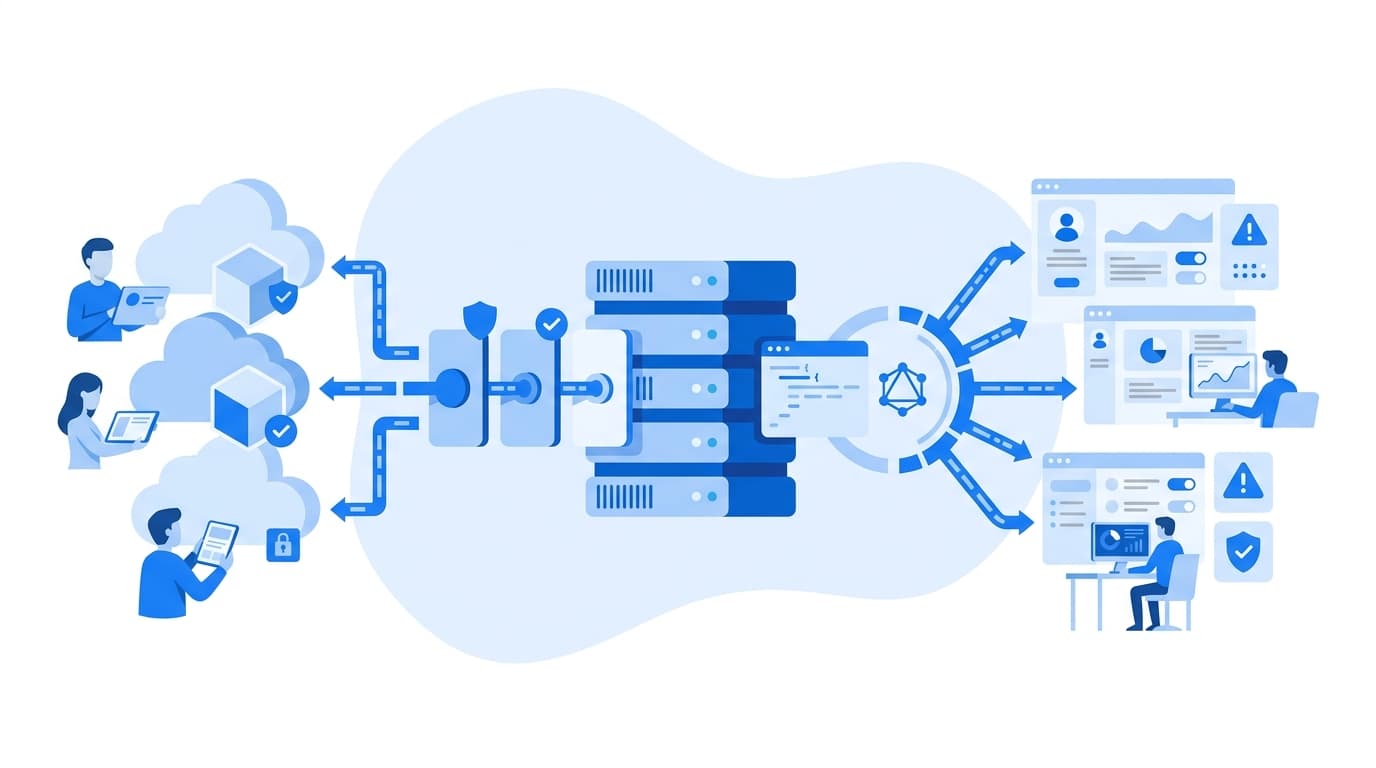
For most enterprises, the answer to REST vs GraphQL is "both, in different places." REST remains the stronger default for public APIs, service-to-service integration, and anything that benefits from HTTP caching and simple operational tooling. GraphQL earns its place when many client applications need flexible, aggregated views over several backend services, and when you have the platform maturity to secure and operate it. The real decision is about which layer of your API architecture each style serves, not about picking a winner.
Below, we walk through how the two approaches differ in practice, where each one creates friction, and a decision framework we use when advising engineering teams.
The Problem Most Teams Are Actually Solving
API architecture debates usually start because something hurts. Common symptoms we see:
- Mobile and web clients making many round trips to assemble a single screen.
- Backend teams fielding constant requests for "one more field" or a slightly different endpoint shape.
- Versioning sprawl, with
/v1,/v2, and/v3endpoints that nobody can safely retire. - Partner integrations that need stable, well-documented contracts and predictable rate limits.
These pain points point in different directions. The first three often push teams toward GraphQL. The last one usually favors REST. Naming the problem first keeps the conversation grounded.
REST vs GraphQL: How They Differ
REST in brief
REST is an architectural style described by Roy Fielding in his 2000 doctoral dissertation, Architectural Styles and the Design of Network-based Software Architectures. In practice, "REST API" usually means resource-oriented URLs, standard HTTP methods, and status codes:
GET /customers/4821
GET /customers/4821/orders?status=open
Each resource has its own endpoint, and the server decides the shape of the response. Contracts are commonly described with the OpenAPI Specification.
GraphQL in brief
GraphQL is a query language and runtime, open-sourced by Facebook in 2015 and now stewarded by the GraphQL Foundation under the Linux Foundation. Clients send a query against a typed schema, usually to a single endpoint, and receive exactly the fields they asked for:
query CustomerSummary {
  customer(id: "4821") {
    name
    tier
    orders(status: OPEN) {
      id
      total
      lineItems { sku quantity }
    }
  }
}
The schema is the contract. It's defined in SDL (Schema Definition Language), and the GraphQL specification governs how queries are validated and executed.
Side-by-side comparison
| Dimension | REST | GraphQL |
|---|---|---|
| Endpoint model | Many resource endpoints | Typically one endpoint |
| Response shape | Server-defined | Client-defined, within the schema |
| HTTP caching | Native (Cache-Control, ETag) |
Requires extra work (persisted queries, GET requests, client caches) |
| Versioning | Often URL- or header-based | Schema evolution with field deprecation |
| Error semantics | HTTP status codes | Usually 200 with an errors array |
| Tooling maturity | Very broad, language-agnostic | Strong, but more opinionated |
| Rate limiting | Per-endpoint, straightforward | Requires query cost analysis |
Where REST Is the Better Fit
REST tends to win when predictability and interoperability matter more than client flexibility.
Public and partner APIs
External consumers want stable contracts, clear documentation, and behavior they can reason about with generic HTTP tools. REST's resource model maps cleanly onto API gateways, WAFs, and per-endpoint rate limits.
Cache-heavy workloads
HTTP caching semantics are standardized in RFC 9111. REST endpoints get CDN and browser caching almost for free:
HTTP/1.1 200 OK
Cache-Control: public, max-age=300
ETag: "a1b2c3"
GraphQL can be cached, but because most queries go to one URL via POST, you typically need persisted queries or GET-based query transport to get comparable edge behavior.
Service-to-service communication
For internal microservice calls, the flexibility of GraphQL is often unnecessary overhead. Many teams use REST or gRPC between services and reserve GraphQL for the client-facing edge.
Simpler operational model
Observability, error handling, and security reviews are easier when each endpoint has a defined purpose and status codes carry meaning. Your on-call engineers will thank you.
Where GraphQL Is the Better Fit
GraphQL tends to win when many clients need different views of the same data.
Multiple frontends with divergent needs
A web dashboard, a mobile app, and an internal admin tool rarely want identical payloads. With GraphQL, each client requests its own shape without the backend team building bespoke endpoints.
Aggregating across domains
A single GraphQL layer, sometimes called a gateway or Backend for Frontend, can compose data from several services. Federated approaches let separate teams own parts of one unified schema.
Reducing over-fetching and under-fetching
Mobile clients on constrained networks benefit from fetching only the fields they render, in one request rather than several.
Evolving without hard version breaks
GraphQL encourages additive change. Fields are deprecated rather than removed abruptly:
type Customer {
  id: ID!
  name: String!
  phone: String @deprecated(reason: "Use contactMethods instead.")
  contactMethods: [ContactMethod!]!
}
This only works if you track field usage and actually retire deprecated fields on a schedule.
The Enterprise Risks of GraphQL You Must Plan For
GraphQL moves complexity from the client to the server. In enterprise settings, we see the same issues surface repeatedly:
- The N+1 query problem. Naive resolvers issue one database call per item in a list. The standard mitigation is batching, for example with the DataLoader pattern.
- Expensive or malicious queries. Deeply nested queries can exhaust resources. The OWASP GraphQL Cheat Sheet recommends depth limits, query cost analysis, timeouts, and disabling introspection in production where appropriate.
- Field-level authorization. Because clients can request any field in the schema, authorization must be enforced in resolvers or a policy layer, not only at the endpoint.
- Observability gaps. Every request hits
/graphqland often returns200, so you need operation-level tracing and error classification.
A minimal hardening setup might look like this (illustrative, using common Node.js libraries):
import depthLimit from 'graphql-depth-limit';

const server = new ApolloServer({
  schema,
  introspection: process.env.NODE_ENV !== 'production',
  validationRules: [depthLimit(8)],
});
For external or high-risk clients, persisted queries (an allow-list of pre-registered operations) are one of the most effective controls, because the server only executes queries it already knows.
A Decision Framework for Your API Architecture
When we help teams choose, we work through these questions in order:
- Who are the consumers? External partners and public developers lean REST. Internal first-party frontends can lean GraphQL.
- How many distinct clients need different data shapes? One or two, REST is usually fine. Many, GraphQL starts paying for itself.
- How important is edge caching? If CDN caching is central to performance or cost, REST is simpler.
- Do you have platform capacity? GraphQL needs schema governance, query cost controls, and resolver performance work. Without an owning team, it degrades quickly.
- What does your compliance posture require? Regulated environments often need precise audit trails and authorization reviews. Both styles can meet these, but GraphQL requires more deliberate design.
The hybrid pattern we recommend most often
- REST (or gRPC) for service-to-service calls and public or partner APIs.
- GraphQL as a client-facing aggregation layer for first-party web and mobile apps.
- OpenAPI and GraphQL SDL both treated as versioned, reviewed contracts in source control.
This keeps external contracts stable while giving product teams the flexibility they want internally.
Migration Without a Big Bang
If you're considering GraphQL on top of existing REST services, you don't need a rewrite. A common path:
- Stand up a GraphQL layer whose resolvers call your existing REST APIs.
- Migrate one client screen or feature at a time.
- Add batching and caching in the resolver layer as hotspots appear.
- Introduce persisted queries and cost limits before exposing the layer more broadly.
If you're working through this kind of transition, our software and platform engineering capabilities cover API design, platform governance, and incremental migration. We also see the trade-offs shift by sector, which is why it's worth looking at how API requirements differ across industries like financial services and healthcare.
FAQ
Is GraphQL faster than REST?
Not inherently. GraphQL can reduce round trips and payload size for complex screens, but poorly written resolvers can be slower than a well-designed REST endpoint. REST often benefits more from HTTP and CDN caching. Performance depends on implementation, not the style itself.
Can REST and GraphQL coexist in the same enterprise?
Yes, and in our experience that's the most common healthy outcome. Many organizations use REST or gRPC between services and expose GraphQL as an aggregation layer for first-party clients.
Is GraphQL secure enough for enterprise use?
It can be, with deliberate controls: query depth and cost limits, field-level authorization, persisted queries, and production introspection settings. The OWASP GraphQL Cheat Sheet is a solid starting checklist.
Should a public API use GraphQL?
It can, but REST is usually the safer default for public and partner APIs because of its broad tooling support, straightforward caching, and simpler rate limiting. If you do expose GraphQL publicly, plan for query cost analysis from day one.
How do I version a GraphQL API?
GraphQL generally favors continuous schema evolution over versioned endpoints. Add new fields, mark old ones with @deprecated, monitor usage, and remove them once clients have migrated.