ISO 27001 vs SOC 2: How to Choose (or Run Both) for Global Buyers
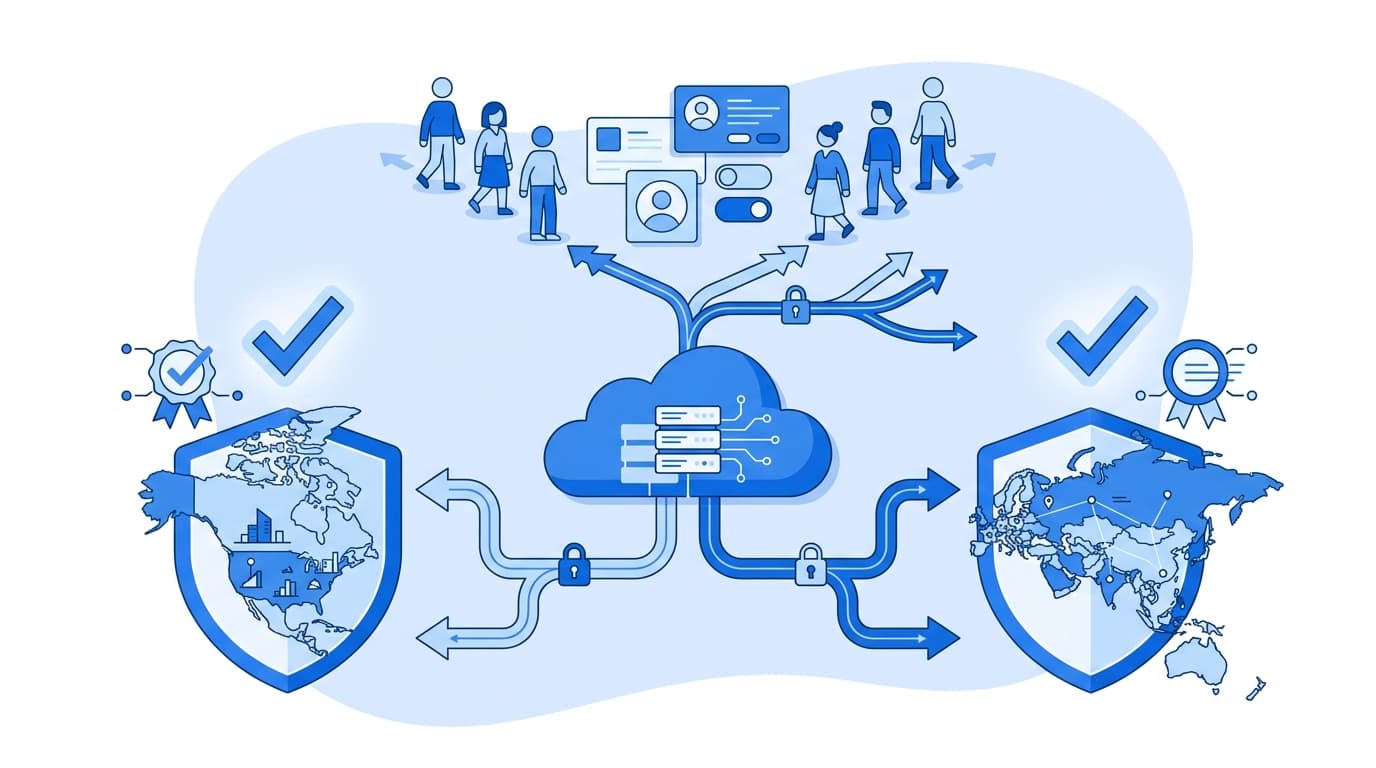
If your buyers are mostly in North America, start with SOC 2 Type II. If they are mostly in Europe, the UK, the Middle East, or Asia-Pacific, start with ISO 27001. If you sell into both markets, plan to run both on a single control framework, sequencing whichever one your largest pipeline deals ask for first. The ISO 27001 vs SOC 2 decision is rarely a question of which standard is "more secure." Both describe credible security programs. The real question is which document your buyers' procurement and security review teams expect to see, and how to avoid building two separate compliance programs to satisfy them.
The rest of this post covers how the two differ, where they overlap, and how we would structure a dual compliance program so the second framework costs a fraction of the first.
ISO 27001 vs SOC 2: What Each One Actually Is
The two are often discussed as if they were interchangeable. They are not, and the differences shape how buyers read them.
ISO/IEC 27001
ISO/IEC 27001 is an international standard for an Information Security Management System (ISMS). The current edition is ISO/IEC 27001:2022, published by ISO and IEC (iso.org).
Key characteristics:
- It is a certification. An accredited certification body audits you and, if you pass, issues a certificate.
- It certifies a management system, not just a set of controls. Auditors look at risk assessment, management review, internal audit, and continual improvement (Clauses 4 through 10).
- Annex A lists 93 reference controls in the 2022 edition, grouped into four themes: organizational, people, physical, and technological. You select applicable controls through your risk assessment and justify inclusions and exclusions in a Statement of Applicability (SoA).
- The certificate runs on a three-year cycle, with a full certification audit, annual surveillance audits, and a recertification audit.
- The certificate itself is public-facing. A buyer can verify it, though the details of your ISMS stay internal.
Organizations certified to the 2013 edition had a transition deadline of 31 October 2025 to move to the 2022 version, per the IAF transition requirements (IAF MD 26). If a vendor still shows a 2013 certificate, it is worth asking about.
SOC 2
SOC 2 is an attestation report under the AICPA's System and Organization Controls framework (aicpa-cima.com). It is evaluated against the Trust Services Criteria (TSC): Security (required), plus optional Availability, Processing Integrity, Confidentiality, and Privacy.
Key characteristics:
- It is not a certification. A licensed CPA firm issues an opinion on whether your controls are suitably designed (Type I) or suitably designed and operating effectively over a period (Type II). "SOC 2 certified" is a common but inaccurate phrase.
- You write your own control descriptions that map to the criteria. Two SOC 2 reports can look quite different.
- Type II covers an observation window, commonly between three and twelve months, during which the auditor samples evidence.
- The report is restricted-use. Buyers usually receive it under NDA. It includes the auditor's tests and any exceptions, which is exactly why security reviewers like it.
Where They Overlap and Where They Diverge
Most of the technical substance overlaps. Access control, change management, logging and monitoring, vendor management, incident response, encryption, and HR security appear in both. AICPA publishes a mapping between the TSC and ISO 27001 controls, which is a useful starting point for a crosswalk.
The meaningful differences:
| Dimension | ISO 27001 | SOC 2 |
|---|---|---|
| Output | Certificate | Auditor's opinion report |
| Auditor | Accredited certification body | Licensed CPA firm |
| Focus | Management system and risk process | Control design and operating effectiveness |
| Scope definition | ISMS scope statement + SoA | System description + selected TSC |
| Evidence depth shown to buyer | Low (certificate) | High (tests, exceptions) |
| Geographic expectation | Strong globally, especially EU/UK/APAC | Strong in North America |
| Renewal | 3-year cycle, annual surveillance | Annual report, typically |
ISO 27001 adherence demands governance artifacts that SOC 2 does not formally require: a documented ISMS, management review minutes, an internal audit program, and an SoA. SOC 2, in turn, demands sustained operating evidence across the window, which forces discipline on things like quarterly access reviews actually happening on schedule.
How to Decide: A Practical Sequence
When we work through this decision with engineering and security leaders, we use four questions.
- What are buyers asking for in security questionnaires today? Pull the last few quarters of RFPs and vendor assessments. Count which framework is named. This is your strongest signal, and it beats any general guidance, including ours.
- Where is your expansion pipeline? If your next market is Germany or Singapore, a SOC 2 report alone may stall procurement. If it is US enterprise or US healthcare, ISO alone may draw follow-up requests for a SOC 2.
- Do you need to show depth or breadth? A SOC 2 Type II shows a reviewer exactly what was tested. An ISO certificate shows an independent body has validated your management system. Some buyers want one; mature buyers often want both.
- What is your current governance maturity? If you lack a risk register, policy ownership, and management review, ISO 27001 forces you to build them. That work also makes your SOC 2 easier.
For organizations selling to global buyers across several sectors, we usually recommend picking the framework demanded by the largest near-term revenue, while designing controls for both from day one. Sector context matters too: regulated buyers in finance or healthcare layer their own requirements on top, which is worth reviewing alongside the industries we commonly see these requirements in.
Running Both: Build One Control Framework, Not Two
The expensive mistake is treating dual compliance as two projects with two evidence sets, two policy libraries, and two audit calendars. The efficient approach is a unified control framework (UCF): one internal control catalog, each control mapped to the ISO Annex A references and TSC criteria it satisfies.
Structure the control catalog as code
Keeping the catalog in version control gives you review history, ownership, and an easy way to generate auditor crosswalks. A minimal structure might look like this:
# controls/access-review.yaml
id: AC-04
title: Quarterly privileged access review
owner: platform-security
frequency: quarterly
description: >
  Privileged access to production systems is reviewed each quarter by the
  system owner. Unneeded access is revoked within 5 business days.
mappings:
  iso27001_2022:
    - A.5.15   # Access control
    - A.5.18   # Access rights
    - A.8.2    # Privileged access rights
  soc2_tsc:
    - CC6.1
    - CC6.2
    - CC6.3
evidence:
  - type: export
    source: idp
    query: privileged_group_members
  - type: ticket
    source: jira
    jql: 'project = SEC AND labels = access-review'
Control IDs should be your own. Treat the framework references as mappings, so adding a third framework later (for example, a regional regulation) means adding mapping entries rather than rewriting controls.
Automate evidence once, use it twice
Most evidence for operating effectiveness is the same for both audits. A scheduled job that snapshots configuration and stores it immutably serves both auditors:
#!/usr/bin/env bash
# Nightly evidence snapshot: IAM users and MFA status
set -euo pipefail
DATE=$(date -u +%Y-%m-%d)
aws iam generate-credential-report >/dev/null
sleep 10
aws iam get-credential-report --query Content --output text \
  | base64 --decode > "iam-credential-report-${DATE}.csv"
aws s3 cp "iam-credential-report-${DATE}.csv" \
  "s3://compliance-evidence/iam/${DATE}/" \
  --sse aws:kms
Pair this with an S3 bucket using Object Lock so evidence cannot be altered after collection. Auditors value tamper-evidence, and your team stops scrambling for screenshots at audit time.
Align scope and calendars
- Match scope boundaries. If your SOC 2 system description covers the production SaaS platform but your ISMS scope covers the whole company, document how they relate. Misaligned scope is a common source of buyer confusion.
- Align the SOC 2 observation window with ISO surveillance timing so the same quarter's evidence feeds both.
- Run one internal audit program that tests controls against both mappings. ISO requires internal audit; SOC 2 benefits from it.
- Keep one policy library. Write policies once and reference both frameworks in a mapping appendix.
Sequencing in practice
A sequence we find workable:
- Build the UCF, risk assessment, and policy set.
- Complete a SOC 2 Type I or ISO Stage 1 audit, whichever buyers need first.
- Start the SOC 2 Type II observation window and the ISO Stage 2 audit in overlapping periods.
- Consolidate into a single annual compliance calendar.
This is the kind of program where engineering ownership matters more than paperwork. Controls that live in infrastructure code, CI pipelines, and identity configuration survive audits far better than controls that live only in a policy document. If you are weighing how to staff that work, our capabilities overview outlines the cloud and security engineering disciplines involved.
Common Pitfalls
- Buying a framework before understanding buyer demand. Check the questionnaires first.
- Over-scoping the first audit. Start with the system buyers actually evaluate, then expand.
- Treating the SoA as a formality. ISO auditors read exclusions closely. Justify each one.
- Letting Type II evidence lapse mid-window. A missed quarterly review becomes an exception in your report, and buyers will read it.
- Assuming a certificate answers every question. Many enterprise buyers still send questionnaires. Maintain a pre-filled response library (SIG or CAIQ formats) mapped to your UCF.
FAQ
Is ISO 27001 or SOC 2 harder to achieve?
Neither is universally harder. ISO 27001 demands more governance structure (ISMS, management review, internal audit, SoA), while SOC 2 Type II demands sustained operating evidence across an observation window. Organizations with weak governance often find ISO harder initially; those with inconsistent operational routines often find SOC 2 Type II harder.
Will a SOC 2 report satisfy European buyers?
Sometimes, but not reliably. Many European, UK, and APAC procurement teams specifically request ISO 27001 certification. A SOC 2 report can support the conversation, but if those markets matter to your pipeline, plan for ISO 27001.
Can one audit firm perform both?
Some firms offer both services, but the roles are distinct: SOC 2 must be issued by a licensed CPA firm, and ISO 27001 certification must come from an accredited certification body. Some providers have separate entities or partnerships to cover both. Coordinating timing with one provider can reduce duplicate evidence requests.
Should we start with SOC 2 Type I or go straight to Type II?
A Type I gives you a report quickly to unblock deals and validates control design before the observation window starts. Going straight to Type II avoids paying for an extra report. If deals are waiting on a report now, Type I first is usually the pragmatic choice.
How does ISO 27001 adherence relate to ISO 27701 or other standards?
ISO/IEC 27701 extends an ISO 27001 ISMS to cover privacy information management, so it requires 27001 as a foundation. A unified control framework makes adding 27701, or SOC 2's Privacy criterion, an incremental mapping exercise rather than a new program.