Key Patterns for Building Scalable Enterprise APIs with Node.js
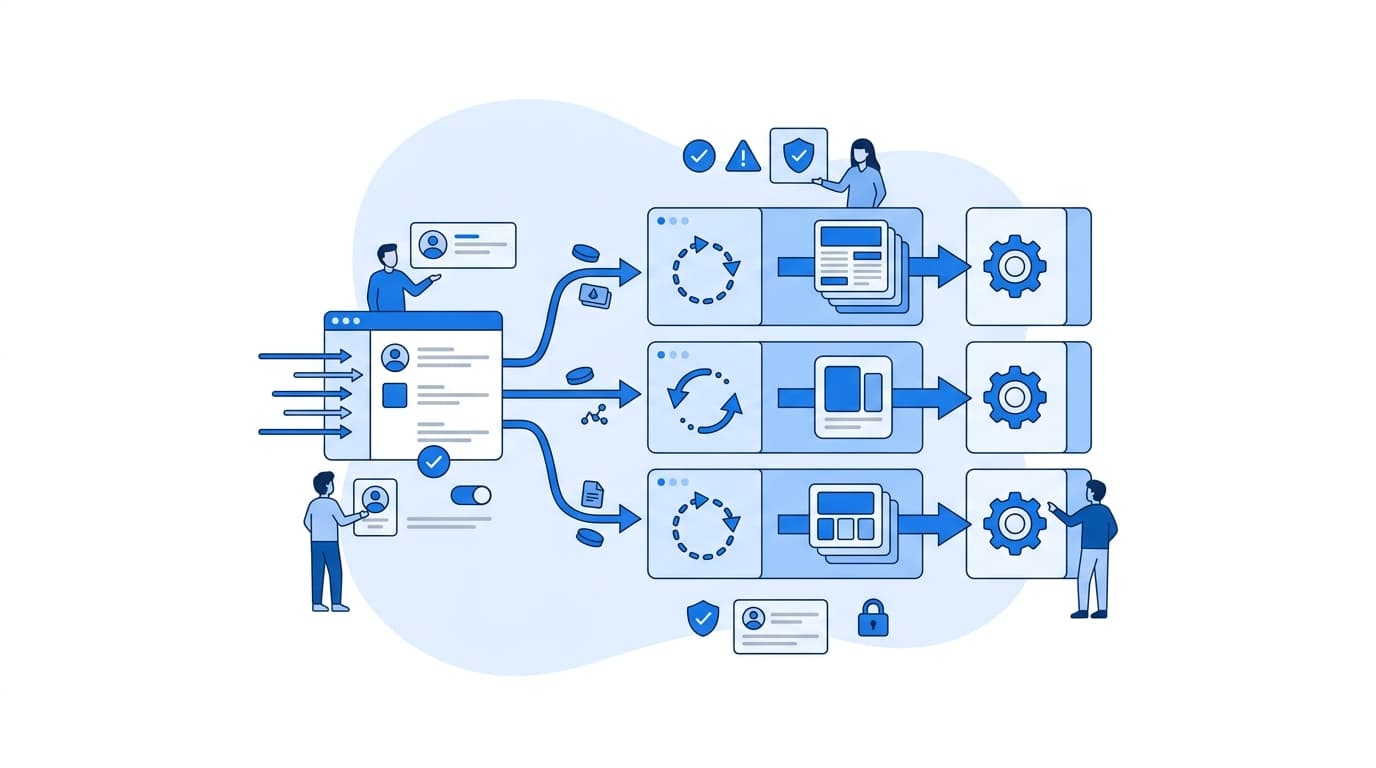
Building a scalable Node.js API comes down to a handful of patterns applied consistently:
- Keep processes stateless so you can scale horizontally.
- Protect the event loop from CPU-heavy work.
- Validate every request at the edge.
- Put timeouts and limits on every outbound call.
- Make writes idempotent.
- Move slow work to queues.
- Instrument everything so you can see problems before your users do.
None of these patterns depends on a specific framework. Together they let an enterprise API absorb more traffic, more teams, and more integrations without a rewrite.
The difficulty is that most Node.js APIs start small and fast, then degrade quietly. Latency creeps up under load, one slow downstream service stalls everything, and a deploy drops in-flight requests. Below, we walk through the patterns we rely on, why each one matters, and what the implementation looks like in practice.
Why Node.js API Architecture Breaks Down at Scale
Node.js runs your JavaScript on a single thread with an event loop that handles I/O asynchronously. This model handles many concurrent connections efficiently because the process is rarely waiting on anything. The tradeoff is spelled out in the official Node.js guide Don't Block the Event Loop: if any one request does expensive synchronous work, every other request on that process waits.
At enterprise scale, three pressures expose this:
- Traffic growth. More concurrent requests magnify the cost of any blocking operation.
- Integration sprawl. Each new downstream dependency is another place where latency and failures can leak into your API.
- Team growth. Without clear structure, a codebase shared by several teams accumulates inconsistent error handling, validation, and logging.
The patterns below address each of these.
Pattern 1: Stateless Processes and Horizontal Scaling
The first rule of a scalable Node.js API is that no request should depend on in-process memory from a previous request. Sessions, uploaded files, rate-limit counters, and caches that must be shared belong in external stores such as Redis, object storage, or a database. This follows the "processes" factor of The Twelve-Factor App.
Once processes are stateless, you can scale out by running more of them behind a load balancer. That might mean container replicas in Kubernetes, the Node.js cluster module on a single host, or both. Statelessness also makes deploys and autoscaling routine instead of risky.
Check yourself: if killing a random instance mid-traffic causes user-visible errors beyond the requests it was serving, you have hidden state.
Pattern 2: Protect the Event Loop
Common blockers in enterprise APIs include:
- Large
JSON.parse/JSON.stringifycalls on multi-megabyte payloads - Synchronous crypto or compression
- Complex regular expressions on user input, which carry ReDoS risk
- In-memory sorting or transformation of large result sets
Push CPU-bound work to worker_threads, a separate service, or a background job. Then measure event loop delay so regressions show up in your dashboards rather than in incident reports:
import { monitorEventLoopDelay } from 'node:perf_hooks';

const histogram = monitorEventLoopDelay({ resolution: 20 });
histogram.enable();

setInterval(() => {
  // Values are reported in nanoseconds
  const p99ms = histogram.percentile(99) / 1e6;
  metrics.gauge('event_loop_delay_p99_ms', p99ms);
  histogram.reset();
}, 10_000);
Alert on sustained increases in p99 delay. A rising trend usually points to a specific code path that has started doing too much synchronous work.
Pattern 3: Layered Structure and Contract-First Design
Enterprise APIs live for years and pass through many hands. We recommend a layered structure that keeps responsibilities separate:
- Transport layer (routes, controllers): parses HTTP, applies auth, maps to and from DTOs.
- Service layer: business rules, orchestration, transactions.
- Data access layer (repositories, clients): databases, caches, external APIs.
Pair this with contract-first design using an OpenAPI specification. When the contract is the source of truth, you can generate client SDKs, run contract tests in CI, and review API changes before anyone writes code. This matters more as the number of consuming teams grows.
Validate at the Edge
Every inbound request should be validated against a schema before it reaches business logic. Frameworks like Fastify support JSON Schema natively. Libraries such as Zod work well with Express or other frameworks.
app.post('/orders', {
  schema: {
    body: {
      type: 'object',
      required: ['customerId', 'items'],
      additionalProperties: false,
      properties: {
        customerId: { type: 'string', format: 'uuid' },
        items: {
          type: 'array',
          minItems: 1,
          maxItems: 100,
          items: {
            type: 'object',
            required: ['sku', 'quantity'],
            properties: {
              sku: { type: 'string', maxLength: 64 },
              quantity: { type: 'integer', minimum: 1 }
            }
          }
        }
      }
    }
  }
}, createOrderHandler);
Note the maxItems and maxLength bounds. Limits are a scalability feature, not only a security one. Unbounded inputs lead directly to unbounded processing time.
Pattern 4: Timeouts, Pooling, and Backpressure on Every Dependency
A Node.js API is only as reliable as its slowest dependency. If a downstream service hangs and you have no timeout, requests pile up, memory grows, and the instance eventually falls over. Apply these rules to every outbound call:
- Set explicit timeouts. Never rely on defaults.
- Use connection pooling for databases and HTTP clients, and size pools deliberately.
- Retry only idempotent operations, with exponential backoff and jitter.
- Use circuit breakers for dependencies that fail in bursts, so you fail fast instead of queueing.
In modern Node.js (v18+), the built-in fetch supports abort signals:
async function getInventory(sku) {
  const res = await fetch(`${INVENTORY_URL}/items/${sku}`, {
    signal: AbortSignal.timeout(2000)
  });
  if (!res.ok) throw new UpstreamError('inventory', res.status);
  return res.json();
}
Also apply backpressure at your own front door. Rate limiting per client, plus a cap on concurrent in-flight requests per instance, keeps one noisy consumer from degrading service for everyone else.
Pattern 5: Idempotent Writes and Asynchronous Work
Idempotency Keys
Networks fail, clients retry, and load balancers replay. Without idempotency, a retried POST /payments can charge twice. The common pattern works like this:
- The client sends an
Idempotency-Keyheader with each write. - The server stores the key alongside the result.
- On a repeat request, the server returns the stored result instead of executing again.
The IETF HTTPAPI working group has a draft standardizing this header.
async function idempotency(req, reply) {
  const key = req.headers['idempotency-key'];
  if (!key) return reply.code(400).send({ title: 'Idempotency-Key required' });

  const cached = await redis.get(`idem:${key}`);
  if (cached) return reply.send(JSON.parse(cached));

  // Reserve the key so concurrent duplicates do not both execute
  const reserved = await redis.set(`idem:${key}:lock`, '1', 'NX', 'EX', 30);
  if (!reserved) return reply.code(409).send({ title: 'Request in progress' });
}
This is a simplified sketch. A production version also scopes keys per client, stores the response after the handler completes, and sets a retention window.
Queue Slow Work
Anything that does not need to finish before the response, such as sending email, generating reports, syncing to a CRM, or calling slow partner APIs, belongs on a durable queue. Return 202 Accepted with a status resource the client can poll, or notify the client by webhook. This keeps request latency predictable and lets you scale workers independently of API instances.
Pattern 6: Consistent Errors, Caching, and Pagination
These patterns rarely get attention in design reviews, but they decide how pleasant your API is to consume at scale.
- Errors: Adopt RFC 9457 (Problem Details for HTTP APIs) for a single machine-readable error format across every service. Consumers write one error handler instead of many.
- Caching: Use HTTP caching semantics (
Cache-Control,ETag, conditional requests) as defined in RFC 9111 for cacheable reads. Add an application cache like Redis for expensive computed data, with explicit TTLs and an invalidation strategy. - Pagination: Prefer cursor-based pagination over offset pagination for large or frequently changing datasets. Deep offsets get slower as the database scans past skipped rows, and they can return duplicates or skip records when data changes between pages.
- Versioning: Pick one strategy, either a URL prefix or a header, and document your deprecation policy before you need it.
Pattern 7: Observability and Graceful Lifecycle
You cannot scale what you cannot see. At minimum:
- Structured JSON logs (for example with Pino) that include a request or correlation ID
- Distributed tracing with OpenTelemetry, so a slow request can be followed across services
- RED metrics (rate, errors, duration) per route
- Separate liveness and readiness endpoints, so orchestrators restart unhealthy pods and stop routing traffic to unready ones
Finally, handle shutdown properly. Orchestrators send SIGTERM before killing a container. If you exit immediately, in-flight requests fail on every deploy.
process.on('SIGTERM', async () => {
  app.log.info('SIGTERM received, draining');
  try {
    await app.close();      // stop accepting connections, finish in-flight requests
    await db.end();         // close pools
    process.exit(0);
  } catch (err) {
    app.log.error(err, 'shutdown failed');
    process.exit(1);
  }
});
Make sure your orchestrator's termination grace period is longer than your slowest expected request.
Putting the Patterns Together
You do not need every pattern on day one. A practical order of adoption:
- Statelessness, input validation, and timeouts
- Structured logging, metrics, and graceful shutdown
- Idempotency and queues for critical write paths
- Tracing, caching, and circuit breakers as dependencies multiply
The right emphasis also depends on your domain. Regulated sectors put more weight on audit logging and idempotency, while high-traffic consumer platforms lean harder on caching and backpressure. You can see how these concerns vary across the industries we work with. If you want help applying these patterns to an existing platform, our software and platform engineering capabilities cover architecture reviews through hands-on delivery.
Further Reading
- Node.js, Don't Block the Event Loop (or the Worker Pool)
- Node.js API docs: worker_threads and perf_hooks
- The Twelve-Factor App
- RFC 9457: Problem Details for HTTP APIs
- RFC 9111: HTTP Caching
- IETF draft: The Idempotency-Key HTTP Header Field
- OpenTelemetry for JavaScript
FAQ
Is Node.js a good choice for enterprise APIs?
Yes, for I/O-heavy workloads such as API gateways, aggregation layers, and CRUD services. Its non-blocking model handles high concurrency efficiently. It is a weaker fit for sustained CPU-bound computation unless you offload that work to worker threads or separate services.
Should I use Express, Fastify, or NestJS?
All three can support a scalable Node.js API. Fastify offers built-in schema validation and serialization. NestJS provides an opinionated layered structure that helps larger teams. Express has the broadest ecosystem. The patterns in this post matter more than the framework you choose.
How do I scale a Node.js API across multiple CPU cores?
Run multiple processes. You can use the cluster module or a process manager on a single host, or more commonly, run multiple container replicas behind a load balancer. This only works cleanly if your processes are stateless.
What is the most common scalability mistake in Node.js APIs?
Missing timeouts on outbound calls, closely followed by blocking the event loop. Either one can let a single slow dependency or expensive request degrade the entire service.
When should I introduce a message queue?
Introduce one as soon as any request performs work the client does not need to wait for, or calls a dependency whose latency you cannot control. Queues keep response times predictable and let you scale background processing independently.