ISO 27001 vs SOC 2: Choosing the Right Framework for Compliance Automation
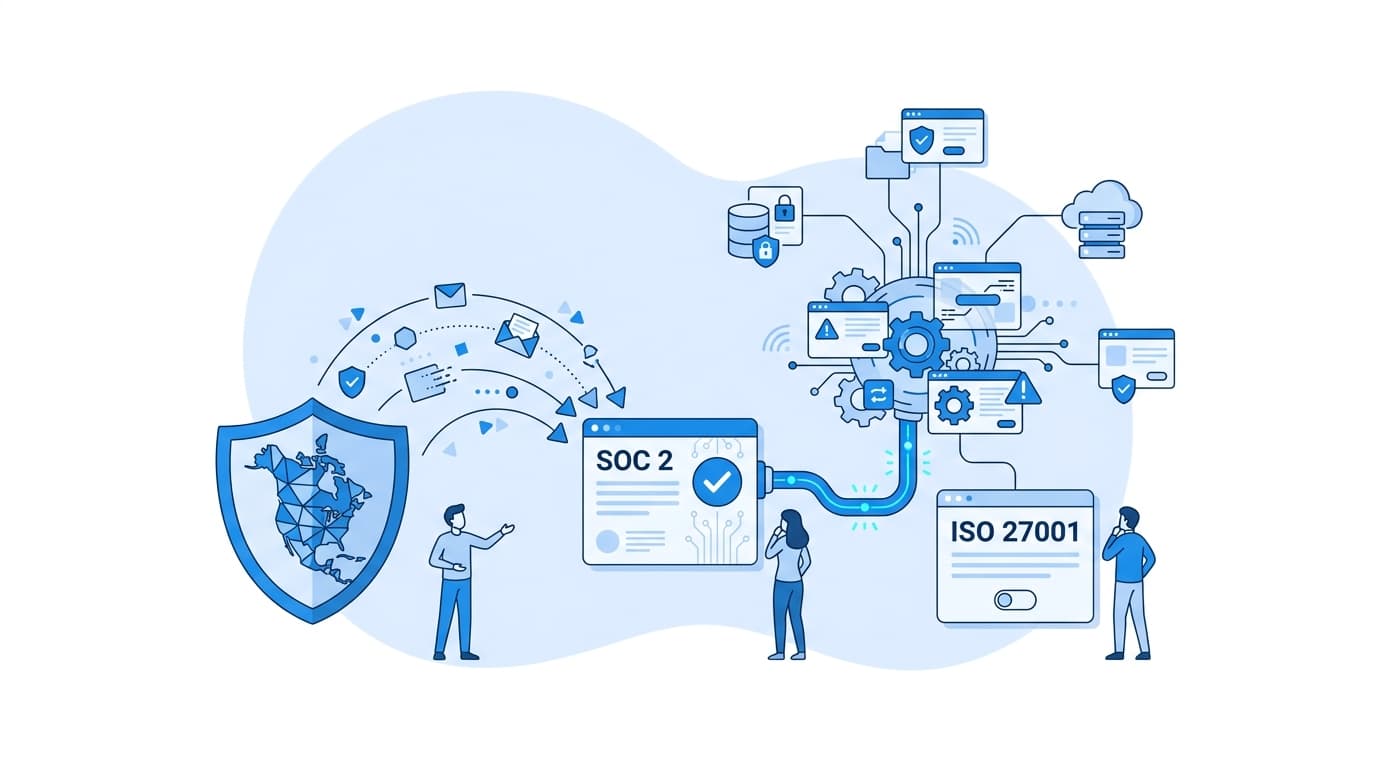
In the ISO 27001 vs SOC 2 decision, the right choice is usually determined by your customers. If your buyers are mostly North American enterprises that send security questionnaires asking for "your SOC 2 Type II report," start with SOC 2. If you sell into Europe, Asia-Pacific, or the public sector, or you need a certificate that signals an organization-wide management system, start with ISO 27001. If you sell to both, plan for both from day one. The two frameworks overlap heavily, and a well-designed compliance automation program can serve both with one control set and one evidence pipeline.
The rest of this post explains the structural differences that drive that decision, where the frameworks overlap, and how we approach automating evidence so the second framework costs far less than the first.
ISO 27001 vs SOC 2: What Each Framework Actually Is
Teams often treat these as interchangeable "security badges." They are different instruments that produce different artifacts.
ISO/IEC 27001
ISO/IEC 27001 is an international standard for an Information Security Management System (ISMS). The current version is ISO/IEC 27001:2022.
- Core requirement: Clauses 4 through 10 define how you run the ISMS: context, leadership, planning, risk assessment and treatment, support, operation, performance evaluation, and improvement.
- Controls: Annex A lists 93 controls grouped into four themes: organizational, people, physical, and technological. You select applicable controls through a risk assessment and justify your choices in a Statement of Applicability (SoA).
- Outcome: A certificate issued by an accredited certification body. It runs on a three-year cycle with annual surveillance audits and a recertification audit at the end.
- Audience: Public. You can publish the certificate and share it freely.
SOC 2
SOC 2 is an attestation framework from the American Institute of Certified Public Accountants (AICPA), built on the Trust Services Criteria (TSC).
- Criteria: Security (the "common criteria," always in scope), plus optional Availability, Processing Integrity, Confidentiality, and Privacy.
- Report types: A Type I report evaluates control design at a point in time. A Type II report evaluates whether controls operated effectively over a review period, which is typically several months to a year.
- Outcome: An attestation report issued by a licensed CPA firm, including the auditor's opinion, your system description, and the tested controls with any exceptions.
- Audience: Restricted. The report is generally shared under NDA with customers and prospects.
The Differences That Matter for Your Decision
Certificate vs. attestation
ISO 27001 gives you a pass/fail certificate against a standard. SOC 2 gives you an auditor's opinion plus detailed testing results. Procurement teams that want a quick yes/no often prefer the certificate. Security reviewers who want to see how you operate, including any exceptions, often prefer the SOC 2 Type II report.
Management system vs. control operation
ISO 27001 adherence is fundamentally about the management system. Auditors want evidence that leadership is engaged, risks are assessed and treated, internal audits happen, and nonconformities drive corrective action. A company with strong technical controls but no functioning risk process will struggle.
SOC 2 is centered on whether the controls you describe actually operated during the period. Process maturity matters, but the emphasis is on sampled evidence: tickets, logs, access reviews, and change approvals.
Scope flexibility
Both frameworks let you define scope, but they do so differently. ISO 27001 scope is defined in your ISMS and appears on the certificate. SOC 2 scope is defined by the system description and the TSC categories you include. Many SaaS companies start SOC 2 with Security only and add Availability or Confidentiality later.
Ongoing effort
Neither is a one-time project. ISO 27001 requires continuous ISMS operation and annual surveillance audits. SOC 2 Type II requires controls to operate continuously because the auditor samples across the entire review period. A gap in month three shows up as an exception in the report.
Quick comparison
| Dimension | ISO 27001 | SOC 2 |
|---|---|---|
| Issuer | Accredited certification body | Licensed CPA firm |
| Artifact | Public certificate | Restricted-use attestation report |
| Basis | ISMS clauses + Annex A controls | AICPA Trust Services Criteria |
| Control selection | Risk-based, documented in SoA | Organization-defined, mapped to TSC |
| Cycle | 3-year certification, annual surveillance | Typically annual Type II report |
| Typical demand | International, regulated, public sector | North American B2B and SaaS |
Where the Frameworks Overlap
In practice, a large share of controls map across both frameworks: access control, change management, logging and monitoring, vendor management, incident response, encryption, and security awareness. The organizations both frameworks expect to see look similar.
That overlap is the foundation of any sensible compliance framework comparison. Design one internal control set, then map it to each framework's requirements, rather than running two parallel programs.
Here is a simplified example of how we structure a unified control in a version-controlled repository:
# controls/access/AC-03-mfa-enforcement.yaml
id: AC-03
title: Multi-factor authentication for privileged and remote access
owner: platform-security
frequency: continuous
description: >
  MFA is enforced for all human access to production cloud accounts,
  identity provider admin consoles, and source control.
mappings:
  iso27001_2022:
    - "A.5.17"   # Authentication information
    - "A.8.5"    # Secure authentication
  soc2_tsc:
    - "CC6.1"    # Logical access security
evidence:
  - type: automated
    source: aws_iam
    check: iam_users_without_mfa
  - type: automated
    source: idp
    check: mfa_policy_enforced
  - type: manual
    artifact: quarterly-access-review
When an auditor from either framework asks for MFA evidence, the same artifacts answer the question. Validate mappings against the official text of each framework. Third-party crosswalks are a helpful starting point, but your auditor decides what satisfies a requirement.
Compliance Automation: Making Either Framework Sustainable
The expensive part of compliance is rarely the first audit. It is collecting evidence continuously, year after year, without pulling engineers off product work. That is where compliance automation earns its keep.
1. Treat evidence as data, not screenshots
Screenshots are hard to verify, easy to forget, and impossible to query. Wherever possible, pull evidence from source systems via API and store it with timestamps and integrity metadata.
# evidence/collect_iam_mfa.py
import boto3, json, hashlib
from datetime import datetime, timezone

def collect():
    iam = boto3.client("iam")
    findings = []
    for page in iam.get_paginator("list_users").paginate():
        for user in page["Users"]:
            mfa = iam.list_mfa_devices(UserName=user["UserName"])["MFADevices"]
            findings.append({
                "user": user["UserName"],
                "mfa_enabled": bool(mfa),
            })

    record = {
        "control_id": "AC-03",
        "collected_at": datetime.now(timezone.utc).isoformat(),
        "source": "aws_iam",
        "results": findings,
        "non_compliant": [f["user"] for f in findings if not f["mfa_enabled"]],
    }
    payload = json.dumps(record, sort_keys=True).encode()
    record["sha256"] = hashlib.sha256(payload).hexdigest()
    return record

if __name__ == "__main__":
    print(json.dumps(collect(), indent=2))
Run collectors on a schedule, write output to immutable storage (for example, an object store with versioning and object lock), and alert on non-compliant results. For SOC 2 Type II, this gives you a dense, sampleable history across the whole review period.
2. Enforce controls before they drift
Detection is good. Prevention is better. Policy-as-code in your infrastructure pipeline stops noncompliant changes before they reach production:
# policy/s3_encryption.rego
package terraform.s3

deny[msg] {
  r := input.resource_changes[_]
  r.type == "aws_s3_bucket_server_side_encryption_configuration"
  not r.change.after.rule[_].apply_server_side_encryption_by_default
  msg := sprintf("S3 bucket %s must enforce default encryption", [r.address])
}
The pipeline run itself becomes evidence: every merge shows the policy check passed.
3. Keep the human controls human, but tracked
Some controls cannot be fully automated: risk assessments, management reviews, access review sign-offs, and incident post-mortems. Automate the workflow instead. Generate the review task on schedule, attach the system data, capture the approver and timestamp, and file the result alongside automated evidence.
4. Map once, report many
With evidence tagged by internal control ID, generating an ISO 27001 SoA view or a SOC 2 control matrix becomes a query rather than a project. This is what makes adding the second framework incremental instead of duplicative.
If you are weighing how to build this kind of pipeline alongside your cloud and platform roadmap, our engineering capabilities overview describes how we approach security and compliance work as part of production engineering.
A Practical Decision Path
- Inventory demand. Review the last year of security questionnaires, RFPs, and lost deals. Note which framework buyers asked for by name.
- Check sector expectations. Regulated sectors and regions often have established preferences. Our industries pages cover how compliance expectations differ across sectors.
- Pick a first framework, but build the control set framework-neutral from the start.
- Automate evidence early. Retrofitting automation after the first audit is harder than building it in.
- Add the second framework when demand justifies it, reusing controls and evidence.
Sources
- ISO, ISO/IEC 27001:2022 Information security, cybersecurity and privacy protection: Information security management systems: Requirements. iso.org/standard/27001
- AICPA, 2017 Trust Services Criteria for Security, Availability, Processing Integrity, Confidentiality, and Privacy (with Revised Points of Focus, 2022). aicpa-cima.com
- AICPA, SOC 2: SOC for Service Organizations: Trust Services Criteria. aicpa-cima.com
FAQ
Is ISO 27001 or SOC 2 harder to achieve?
Neither is universally harder. They are hard in different ways. ISO 27001 demands a functioning management system with risk assessment, internal audit, and leadership review. SOC 2 Type II demands that controls operate consistently across the full review period. Organizations with mature engineering but immature governance often find ISO 27001 more demanding. The reverse is also common.
Can one audit cover both ISO 27001 and SOC 2?
They remain separate engagements with separate deliverables, since one is a certification and the other is a CPA attestation. Some audit firms can perform both and coordinate fieldwork, which reduces duplicated requests. The bigger savings come from a unified control set and shared evidence on your side.
Should we start with SOC 2 Type I or go straight to Type II?
A Type I report can unblock deals quickly by showing your controls are designed appropriately. Many customers ultimately expect Type II, though. A common path is a Type I to establish a baseline, then a Type II review period starting immediately after. Discuss timing with your auditor.
How does compliance automation help with ISO 27001 adherence specifically?
Automation supports Annex A technical controls through continuous evidence collection, and it supports the ISMS clauses by tracking risk reviews, internal audits, and corrective actions as auditable workflows. It does not replace management judgment, but it makes that judgment visible and repeatable for auditors.