How FinOps Principles Shape Cost-Optimized Enterprise Cloud Architecture
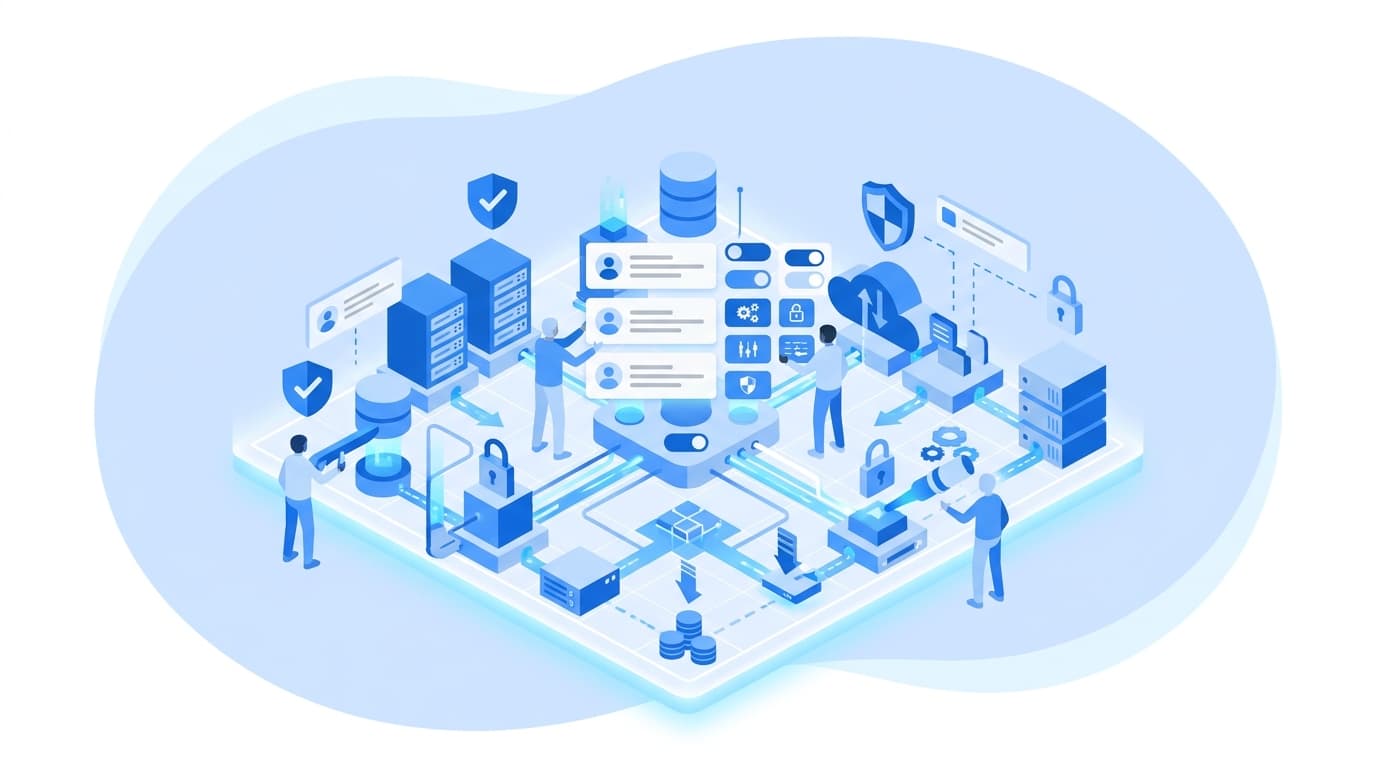
Cost-optimized enterprise cloud architecture comes from applying FinOps principles at design time rather than after the invoice arrives. In practice, FinOps cloud architecture means four things. Every resource can be attributed to an owner. Every workload has a unit cost tied to business value. Elasticity is built into the system rather than bolted on. Cost is a reviewed attribute in architecture decisions, alongside security, reliability, and performance. If you get those four right, cloud cost optimization becomes a continuous engineering practice instead of a quarterly fire drill.
The rest of this post walks through how to put that into practice, with concrete patterns, policy examples, and the trade-offs we think teams should make deliberately.
Why Cloud Cost Becomes an Architecture Problem
Most enterprises start treating cloud spend as a finance problem. Someone in procurement notices the bill growing faster than revenue, a cost-cutting initiative kicks off, and engineers are asked to "find savings." That approach usually yields one round of easy wins: deleting idle resources, resizing obviously overprovisioned instances, buying some commitments. Then it stalls.
It stalls because the remaining cost is structural. It lives in decisions like these:
- A shared Kubernetes cluster with no namespace-level cost attribution, so no team can see what it spends.
- A data pipeline that copies full datasets across regions nightly because that was the simplest design at launch.
- Services sized for peak load around the clock because nobody built autoscaling into the deployment model.
- Logging and observability retention set to "forever" by default.
None of these can be fixed by a finance team. They are architecture decisions, and they need to be revisited by the people who own the architecture. That is the core insight behind the FinOps Foundation's framing: cloud's variable cost model shifts spending decisions to engineers, so engineers need the data, the ownership, and the guardrails to make those decisions well.
The FinOps Principles That Matter Most for FinOps Cloud Architecture
The FinOps Foundation publishes a set of principles and a lifecycle of Inform, Optimize, and Operate phases. We won't restate the full framework here (see the sources at the end), but several principles map directly onto architectural choices:
- Everyone takes ownership of their cloud usage. Architecturally, this requires that cost be attributable. If you cannot map a dollar to a team, product, or environment, ownership is a slogan.
- Business value drives technology decisions. This pushes you toward unit economics, such as cost per transaction, per tenant, or per thousand API calls, instead of raw spend.
- Cost data should be accessible, timely, and accurate. This shapes your tagging strategy, account or project hierarchy, and how you export and normalize billing data.
- Take advantage of the variable cost model. This is where elasticity, right-sizing, and commitment strategy come in.
- A central function enables, teams execute. This argues for platform-level guardrails (policy-as-code, golden templates) rather than manual review gates.
The cloud providers' own guidance reinforces this. The AWS Well-Architected Framework, the Google Cloud Architecture Framework, and the Azure Well-Architected Framework each treat cost optimization as a first-class pillar, not an afterthought.
How to Build a FinOps Cloud Architecture: A Practical Sequence
Here is the sequence we recommend. The order matters: optimization without attribution produces savings nobody can verify or sustain.
Step 1: Make Cost Attributable by Design
Start with your account, subscription, or project hierarchy. Hard boundaries such as separate AWS accounts per workload and environment, or separate GCP projects, give you clean attribution without relying entirely on tags. Use tags or labels for the dimensions that cut across those boundaries: cost center, product, owner, data classification.
Enforce tags at the infrastructure-as-code layer so they are present from the moment a resource exists. In Terraform with the AWS provider, default_tags applies a baseline set to every taggable resource:
provider "aws" {
  region = "us-east-1"

  default_tags {
    tags = {
      cost_center = var.cost_center
      product     = var.product
      environment = var.environment
      owner       = var.owner_team
      managed_by  = "terraform"
    }
  }
}

variable "environment" {
  type = string
  validation {
    condition     = contains(["dev", "staging", "prod"], var.environment)
    error_message = "environment must be one of: dev, staging, prod."
  }
}
Keep the required tag set small. Five well-governed tags beat twenty inconsistently applied ones.
Step 2: Enforce Guardrails in the Pipeline
Tags in templates are not enough on their own. Engineers can override them, and resources created outside IaC skip them entirely. Add a policy check in CI so untagged or non-compliant infrastructure never reaches an environment. Here is a minimal Open Policy Agent rule evaluated against a Terraform plan in JSON form:
package terraform.cost

import rego.v1

required_tags := {"cost_center", "product", "environment", "owner"}

deny contains msg if {
  rc := input.resource_changes[_]
  rc.change.actions[_] in {"create", "update"}
  tags := object.get(rc.change.after, "tags_all", {})
  missing := required_tags - {k | tags[k]}
  count(missing) > 0
  msg := sprintf("%s is missing required tags: %v", [rc.address, missing])
}
Pair this with a cloud-native backstop, such as AWS Organizations tag policies, Azure Policy, or GCP organization policy constraints, to catch anything created through the console.
Step 3: Define Unit Economics
Raw spend tells you how much. Unit cost tells you whether that is reasonable. Pick one or two business metrics per product, then join them with normalized billing data.
The FinOps Open Cost and Usage Specification (FOCUS) is worth adopting here. It defines a common schema for billing data across providers, which simplifies multi-cloud reporting. A simplified query against FOCUS-formatted data might look like this (column names follow FOCUS; adjust tag-access syntax for your query engine):
WITH product_cost AS (
  SELECT
    DATE_TRUNC('month', ChargePeriodStart) AS month,
    Tags['product']                        AS product,
    SUM(EffectiveCost)                     AS effective_cost
  FROM focus_billing
  WHERE Tags['environment'] = 'prod'
  GROUP BY 1, 2
)
SELECT
  c.month,
  c.product,
  c.effective_cost,
  m.transactions,
  c.effective_cost / NULLIF(m.transactions, 0) * 1000 AS cost_per_1k_txn
FROM product_cost c
JOIN business_metrics m
  ON m.month = c.month AND m.product = c.product
ORDER BY c.month, c.product;
Once teams see cost per thousand transactions trending over time, conversations shift from "spend is up" to "spend is up, but unit cost is down 'cause volume grew." That is a much healthier discussion.
Step 4: Design for Elasticity and Right-Sizing
This is where architecture choices pay off most directly:
- Scale on demand signals, not schedules alone. Horizontal autoscaling on queue depth or request rate usually tracks real load better than CPU thresholds.
- Scale non-production to zero outside working hours where feasible.
- Match compute model to workload shape. Spiky, event-driven work often suits serverless or containers on spot or preemptible capacity. Steady, predictable workloads often suit reserved or committed capacity.
- Treat data as a cost driver. Storage tiering, lifecycle policies, and minimizing cross-region and egress traffic often matter as much as compute.
- Set retention deliberately for logs, metrics, traces, and backups. Defaults are rarely tuned to your compliance requirements.
Step 5: Commit After Usage Stabilizes
Savings plans, reserved instances, and committed use discounts can meaningfully reduce cost for steady-state workloads. But committing before you right-size locks in waste. Our recommended order is attribute, right-size, observe a stable baseline, then commit to a portion of it, reviewing coverage on a regular cadence.
Step 6: Make Cost a Reviewed Architecture Attribute
Add a cost section to your architecture decision records (ADRs) so trade-offs are explicit and revisitable:
## Cost Considerations
- Primary cost drivers: <compute | storage | egress | licensing>
- Unit metric: <e.g., cost per tenant per month>
- Expected scaling behavior: <linear | step | flat>
- Alternatives considered and relative cost: <...>
- Review trigger: <e.g., unit cost exceeds target for two consecutive months>
This keeps cost in the same conversation as latency, availability, and security, which is exactly where it belongs.
Trade-Offs to Make Deliberately
Cost optimization is not cost minimization. A few tensions deserve explicit decisions rather than defaults:
- Resilience vs. cost. Multi-region active-active is expensive. Decide per workload based on actual recovery objectives, not as a blanket policy.
- Managed services vs. self-managed. Managed services often cost more per unit of infrastructure but less in engineering time and operational risk. Count both.
- Commitment depth vs. flexibility. Deeper commitments save more but reduce your ability to re-architect. Align commitment terms with your modernization roadmap.
- Granular attribution vs. overhead. Per-team accounts and fine-grained tagging improve visibility but add governance work. Scale granularity to organizational maturity.
Connecting FinOps to Enterprise IT Strategy and Digital Transformation Costs
FinOps works best when it is part of enterprise IT strategy, not a standalone cost program. Digital transformation costs are frequently underestimated because migration plans model the target-state run rate but not the transitional period of running old and new systems in parallel, or the cost of re-architecting services that were lifted and shifted. Building attribution and unit economics into the migration plan from the start makes those transitional costs visible and manageable.
Regulatory context also shapes the right answer. Data residency, audit logging, and retention requirements differ across sectors, and they directly affect storage, networking, and observability spend. If you're mapping these considerations to your own environment, our overview of industry-specific cloud and engineering considerations and our cloud, software, and engineering capabilities describe how we approach this kind of work.
Sources
- FinOps Foundation, FinOps Framework (principles, phases, capabilities): finops.org/framework
- FinOps Foundation, FOCUS: FinOps Open Cost and Usage Specification: focus.finops.org
- AWS, Well-Architected Framework: Cost Optimization Pillar: docs.aws.amazon.com/wellarchitected
- Google Cloud, Architecture Framework: Cost Optimization: cloud.google.com/architecture/framework
- Microsoft, Azure Well-Architected Framework: Cost Optimization: learn.microsoft.com/azure/well-architected
- HashiCorp, Terraform AWS Provider: default_tags: registry.terraform.io/providers/hashicorp/aws
FAQ
What is FinOps cloud architecture?
FinOps cloud architecture is the practice of designing cloud systems so that cost is attributable, measurable against business value, and controllable through engineering decisions. It applies FinOps principles such as shared ownership, timely cost data, and use of the variable cost model directly to account structure, tagging, scaling design, and architecture reviews.
Where should an enterprise start with cloud cost optimization?
Start with attribution. Establish a clear account or project hierarchy and a small, enforced set of tags. Without reliable attribution, you cannot assign ownership, measure unit cost, or verify that optimizations actually saved money.
When should we buy reserved instances or savings plans?
After right-sizing and once you have observed a stable usage baseline. Committing first can lock in overprovisioned capacity. Cover a portion of steady-state usage and review coverage regularly as workloads change.
How does FinOps relate to digital transformation costs?
Transformation programs often run legacy and modern systems in parallel for extended periods, and lift-and-shift migrations can carry inefficient designs into the cloud. Building FinOps practices into the transformation plan makes those transitional costs visible and helps prioritize which workloads to re-architect.
Do we need a dedicated FinOps team?
Many organizations benefit from a small central function that owns tooling, data, and guardrails, while product and platform teams own their own usage decisions. The FinOps Foundation framework describes this enable-centrally, execute-locally model. The right size depends on your cloud footprint and organizational maturity.