GraphQL vs. REST: Which API Architecture is Better for Enterprise-Scale Applications?
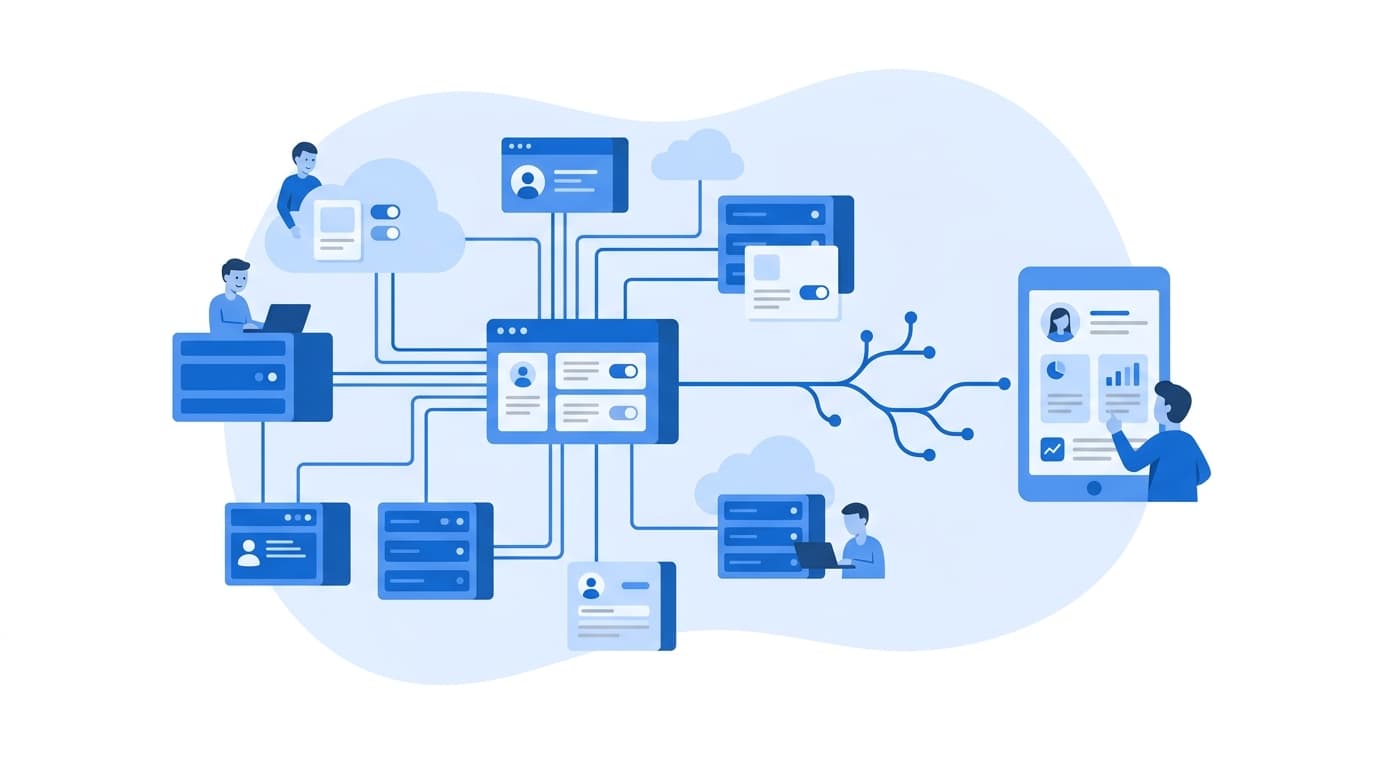
There is no universal winner in the graphql vs rest debate, but there is a reliable default. For most enterprise-scale applications, REST should remain the foundation for service-to-service and public-facing APIs because it is simpler to cache, secure, govern, and operate. GraphQL earns its place as an aggregation layer when many clients with different data needs, especially web and mobile frontends, consume data spread across many backend services. In practice, the strongest enterprise API architecture often uses both: REST (or gRPC) between services, and GraphQL at the edge where client flexibility pays for its operational cost.
The rest of this post explains how we reach that conclusion, where each approach breaks down at scale, and what you need in place before committing to either.
The Problem Enterprise Teams Are Actually Solving
Teams rarely ask "GraphQL or REST?" in the abstract. The question usually surfaces because of a specific pain:
- Frontend teams are blocked waiting for backend teams to add fields or build new endpoints.
- Mobile clients make too many round trips to assemble a single screen.
- Payloads are bloated because endpoints return everything every consumer has ever needed.
- Dozens of microservices each expose their own API, and no one has a coherent view of the data.
These are real problems. But they have different root causes, and only some of them are solved by changing API paradigms. Before choosing an architecture, we recommend naming the specific failure you are trying to fix. If the actual issue is weak API governance or missing documentation, GraphQL will not fix it. It will move the problem somewhere else.
GraphQL vs REST: How the Models Differ
REST: Resources over HTTP
REST, as described in Roy Fielding's 2000 doctoral dissertation, models a system as resources addressed by URIs and manipulated through a uniform interface. In modern practice, that means HTTP methods with well-defined semantics (RFC 9110), standard status codes, and HTTP caching (RFC 9111).
GET /v1/customers/4821/orders?status=open&limit=20 HTTP/1.1
Host: api.example.com
Accept: application/json
If-None-Match: "a7f3c9"
The server owns the response shape. Each endpoint is a contract, typically described with the OpenAPI Specification.
GraphQL: A Typed Query Language over a Schema
GraphQL, defined by the GraphQL specification maintained under the GraphQL Foundation, exposes a single strongly typed schema. Clients send a query describing exactly the fields they want, and the server resolves it.
query CustomerDashboard($id: ID!) {
  customer(id: $id) {
    name
    tier
    openOrders(first: 20) {
      id
      total
      shipment { carrier eta }
    }
  }
}
The client owns the response shape. The schema is the contract, and introspection makes it self-describing.
The Core Trade-off
The key difference is who controls the shape of the data. REST puts that control on the server, which makes behavior predictable and easy to optimize. GraphQL puts it on the client, which makes iteration fast but makes server-side cost harder to predict. Almost every downstream trade-off follows from this one design choice.
Where REST Wins at Enterprise Scale
Caching Is Built In
REST over HTTP inherits decades of caching infrastructure. GET requests with ETag, Cache-Control, and Vary headers work with CDNs, reverse proxies, and browsers without custom code. GraphQL requests are commonly sent as POST to a single endpoint, which most HTTP caches will not store by default. You can recover this (see persisted queries below), but it is work you must deliberately do.
Operational Predictability
Each REST endpoint has a bounded, known cost. You can load test it, set rate limits per route, and read your access logs to see which operations are slow. In GraphQL, one endpoint serves an unbounded set of queries, so per-route metrics tell you very little. You need field-level tracing to get the same visibility.
Security and Authorization Are Easier to Reason About
Authorization in REST can often be enforced at the route and resource level. The OWASP API Security Top 10 (2023) still applies, particularly broken object level authorization, but the surface area is enumerable. In GraphQL, authorization must be enforced at the resolver or field level, because any field can be reached through many query paths.
Mature Governance and Tooling
OpenAPI, contract testing, API gateways, and standardized error formats like RFC 9457 (Problem Details for HTTP APIs) give REST a well-understood governance story. Good rest api design is not glamorous, but it is widely understood by auditors, partners, and new hires.
Where GraphQL Wins at Enterprise Scale
Many Clients, Divergent Needs
When a web app, an iOS app, an Android app, and partner integrations all need different slices of the same data, REST tends to sprawl into client-specific endpoints or a Backend-for-Frontend per client. GraphQL lets each client request precisely what it needs from one schema.
Aggregation Across Microservices
GraphQL for microservices is most compelling as a unified graph over many services. Approaches like Apollo Federation, and the GraphQL Foundation's ongoing Composite Schemas work, let individual teams own subgraphs while clients see a single schema.
# Orders subgraph extends a Customer type owned by another team
type Customer @key(fields: "id") {
  id: ID!
  openOrders(first: Int = 20): [Order!]!
}
This gives frontend teams a coherent data model without forcing backend teams into a single codebase.
Schema-First Collaboration
A typed schema with introspection enables code generation, type-safe clients, and early detection of breaking changes. Frontend and backend teams can agree on the schema first and build in parallel.
The Costs GraphQL Introduces
If you adopt GraphQL, plan for these from day one rather than retrofitting them after an incident.
- The N+1 problem. Naive resolvers issue one database or service call per item in a list. Use batching, typically via the DataLoader pattern.
- Unbounded query cost. A deeply nested query can be expensive enough to degrade a service. Enforce depth limits, complexity scoring, and timeouts. The OWASP GraphQL Cheat Sheet covers these controls.
- Caching. Use persisted queries so that clients send a hash instead of arbitrary query text. This enables
GETrequests, CDN caching, and an allow-list of permitted operations. - Observability. Instrument at the resolver level so you can see which fields drive latency.
- Introspection in production. Many teams disable or restrict introspection for public endpoints to reduce reconnaissance surface.
A minimal example of depth and complexity limits in a Node.js server:
import depthLimit from 'graphql-depth-limit';
import { createComplexityLimitRule } from 'graphql-validation-complexity';

const server = new ApolloServer({
  schema,
  validationRules: [
    depthLimit(8),
    createComplexityLimitRule(1000),
  ],
});
The specific thresholds should come from your own load testing, not from a blog post.
A Practical Decision Framework
We use a short set of questions to guide api architecture decisions for enterprise apis:
| Question | Leans REST | Leans GraphQL |
|---|---|---|
| Who are the consumers? | Partners, public, other services | Your own frontends |
| How many distinct clients? | Few, with similar needs | Many, with divergent needs |
| How important is HTTP caching? | Critical | Manageable with persisted queries |
| How mature is your platform team? | Small or stretched | Able to own a gateway and schema governance |
| Is data spread across many services? | No, or mostly one domain | Yes, and clients need joined views |
If most answers fall in the left column, invest in better REST design: consistent resource naming, versioning policy, OpenAPI contracts, and a gateway. If several answers fall in the right column, consider a GraphQL layer at the edge, backed by REST or gRPC services.
The Hybrid Pattern
For many organizations, the pragmatic architecture looks like this:
- Internal services communicate over REST or gRPC with clear contracts.
- A GraphQL gateway composes those services for first-party web and mobile clients.
- Public and partner APIs stay REST, because external consumers expect predictable, cacheable, well-documented endpoints.
This keeps GraphQL's flexibility where it delivers value and keeps REST's simplicity where predictability matters more.
Migration Without a Rewrite
You do not need to replace existing REST APIs to adopt GraphQL. A common path is to stand up a GraphQL layer whose resolvers call existing REST endpoints, start with one high-value client screen, measure the effect, and expand only if it proves its worth. The reverse also applies: if a GraphQL layer is adding cost without benefit, it can be narrowed while REST services continue to operate underneath.
If you are weighing these trade-offs for a production system, our software and platform engineering capabilities cover API design, gateway architecture, and observability. You can also see how API needs differ by domain across the industries we work with, where regulatory and integration constraints often shape the decision as much as technical preference.
FAQ
Is GraphQL faster than REST?
Not inherently. GraphQL can reduce round trips and payload size for complex client views, which can improve perceived performance. But it can also be slower if resolvers trigger N+1 calls or if responses cannot be cached. Performance depends on implementation, not the paradigm.
Can GraphQL replace REST entirely in an enterprise?
It can, but it rarely should. Public APIs, partner integrations, file transfers, and simple service-to-service calls are usually better served by REST or gRPC. Most enterprises get the best results using GraphQL selectively at the client-facing edge.
Is GraphQL less secure than REST?
Neither is more secure by default. GraphQL has a different attack surface: query depth abuse, batching attacks, and introspection exposure. These are well documented in the OWASP GraphQL Cheat Sheet and can be mitigated with persisted queries, complexity limits, and field-level authorization.
How should we version a GraphQL API compared to a REST API?
REST APIs commonly use explicit versions in the URL or headers. GraphQL typically evolves a single schema continuously, adding fields and marking old ones with the @deprecated directive, then removing them once usage data shows they are no longer requested. This requires field-level usage tracking.
When is GraphQL a poor fit for microservices?
When you have few clients with similar needs, a small platform team, or heavy reliance on HTTP caching, GraphQL adds governance and operational overhead that may outweigh its benefits. In those cases, well-designed REST APIs behind a gateway are usually the simpler, more maintainable choice.