What is LLM Telemetry and Why is it Critical for LLMOps?
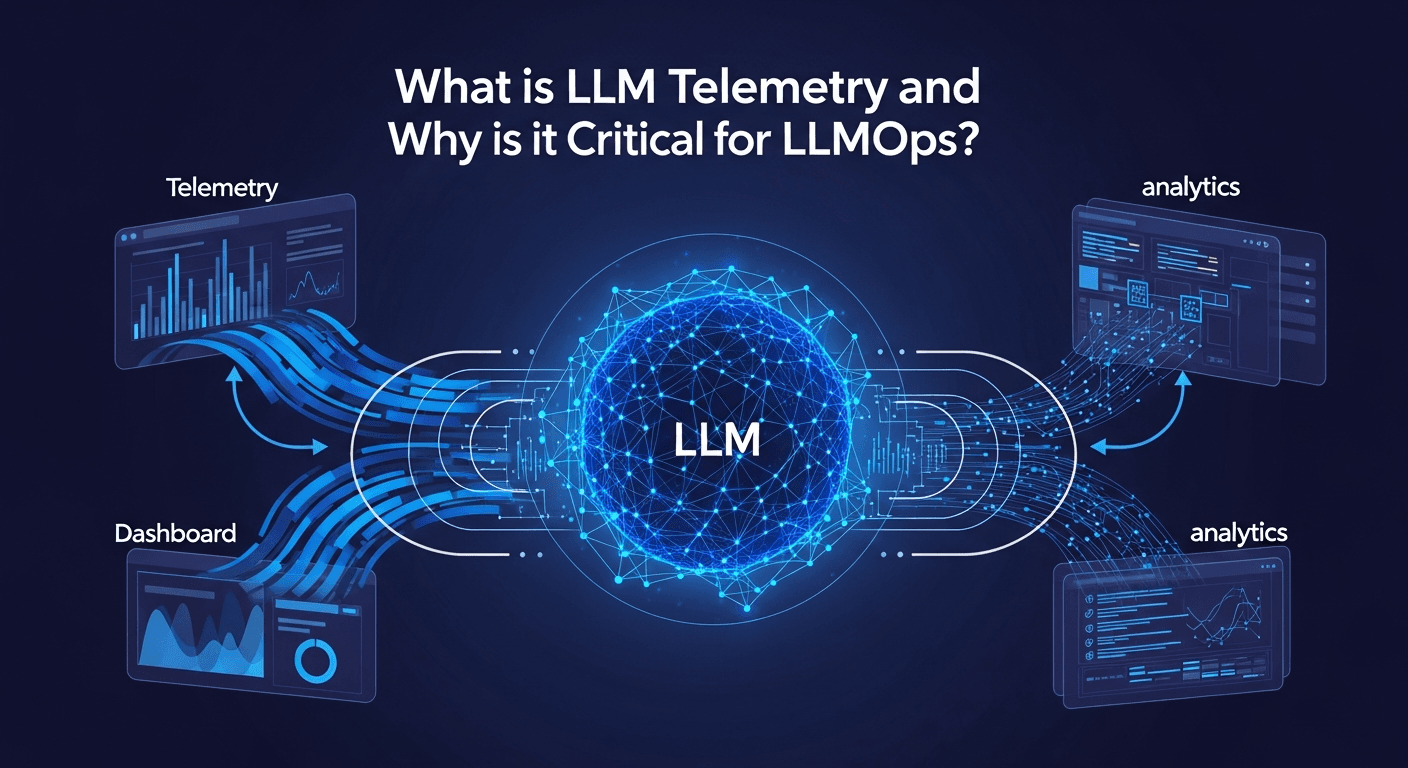
If your large language model application breaks in production, the failure is rarely loud. There is no stack trace, no 500 error, no alert. The model returns a confident, well-formatted answer that happens to be wrong, slow, or expensive. LLM telemetry is the practice of instrumenting your model-powered systems to capture the signals that make these silent failures visible: prompts, completions, token counts, latency, costs, tool calls, retrieval context, and user feedback. So when we ask what is LLM telemetry, the short answer is this: it is the structured, queryable record of everything your model did and why, collected continuously so you can debug, measure, and improve the system over time.
This article explains what that telemetry consists of, why it is foundational to LLMOps, and how to start collecting it without rebuilding your stack.
What is LLM Telemetry, Concretely
Traditional application monitoring assumes deterministic behavior. The same input produces the same output, and a failure is usually a thrown exception or a degraded metric you can chart. LLM systems break both assumptions. The same prompt can produce different outputs across calls. A "successful" HTTP 200 response can still contain a hallucination, a policy violation, or an answer that ignores the retrieved context entirely.
LLM telemetry closes that gap by recording the full context of each interaction. A reasonable telemetry record for a single inference includes:
- Request metadata: model name and version, temperature, top_p, max tokens, system prompt hash.
- Inputs: the rendered prompt, including any injected retrieval context or few-shot examples.
- Outputs: the raw completion, finish reason, and any parsed structured output.
- Performance: time to first token, total latency, queue time.
- Cost signals: prompt tokens, completion tokens, and derived cost per call.
- Trace context: a correlation ID linking the call to upstream requests, retrieval steps, and downstream tool executions.
- Quality signals: user thumbs up/down, downstream conversion, evaluation scores, guardrail flags.
The defining characteristic is that telemetry is structured and joinable. A log line saying "LLM call completed" is nearly useless. A record you can group by model version, filter by cost, and join to a user feedback event is what lets you answer real operational questions.
Telemetry vs. Logging vs. Observability
These terms get used interchangeably, but the distinction matters when you design a system:
- Logging is the raw event stream. It tells you what happened.
- Telemetry is the curated, structured set of measurements emitted on purpose. It is the data you decided in advance you would need.
- LLM observability is the property you achieve when your telemetry is rich enough to explain novel failures you did not anticipate, without shipping new code to investigate.
You collect telemetry. You achieve observability. The goal of our data and AI engineering work is to get teams from one to the other.
Why Telemetry Is Critical for LLMOps
LLMOps is the discipline of running model-powered systems reliably in production. Telemetry is the substrate that makes every other LLMOps principle achievable. Without it, you are operating blind.
1. You Cannot Debug What You Cannot Reconstruct
When a user reports a bad answer, the first question is "what exactly did the model see?" If you only stored the user's question and not the full assembled prompt, including the retrieved documents and the system instructions in effect at that moment, you cannot reproduce the failure. With proper trace-level telemetry, you replay the exact context and isolate whether the problem was bad retrieval, a flawed prompt template, or model behavior.
2. Quality Drifts Silently
Model providers update endpoints. Your retrieval index grows stale. A prompt change ships that helps one use case and quietly degrades another. None of these produce errors. They produce drift, and the only way to catch drift is to measure quality over time. Telemetry feeds your evaluation pipeline, letting you track metrics like groundedness, answer relevance, and refusal rate across versions.
3. Cost Is a First-Class Operational Risk
Token-based pricing means a single inefficient prompt template, deployed at scale, can produce a surprising invoice. Telemetry that records per-call token counts lets you attribute cost to features, tenants, and prompts. You can then answer questions that finance and engineering both care about, such as which feature drove last month's spend and which prompts are bloated with unused context.
4. Safety and Compliance Require an Audit Trail
In regulated environments, you must be able to demonstrate what the system told a user and what controls were in place. This is acutely true in sectors like the ones we cover in financial services and healthcare, where an unexplained model output is not just a bug but a potential liability. Telemetry is your audit trail.
A Minimal Instrumentation Pattern
You do not need a new platform to start. The OpenTelemetry standard gives you vendor-neutral primitives, and the emerging GenAI semantic conventions define standard attribute names for model calls. Here is a stripped-down example wrapping a model call in a span.
from opentelemetry import trace

tracer = trace.get_tracer("llm.app")

def call_model(client, system_prompt, user_prompt, context_docs):
    with tracer.start_as_current_span("llm.chat") as span:
        prompt = render_prompt(system_prompt, context_docs, user_prompt)

        # GenAI semantic convention attributes
        span.set_attribute("gen_ai.system", "openai")
        span.set_attribute("gen_ai.request.model", "gpt-4o-mini")
        span.set_attribute("gen_ai.request.temperature", 0.2)

        response = client.chat.completions.create(
            model="gpt-4o-mini",
            temperature=0.2,
            messages=prompt,
        )

        usage = response.usage
        span.set_attribute("gen_ai.usage.input_tokens", usage.prompt_tokens)
        span.set_attribute("gen_ai.usage.output_tokens", usage.completion_tokens)
        span.set_attribute("gen_ai.response.finish_reason",
                           response.choices[0].finish_reason)

        # Store inputs/outputs as span events, not just attributes,
        # to keep large payloads out of indexed fields.
        span.add_event("gen_ai.content.prompt",
                       {"content": json.dumps(prompt)})
        span.add_event("gen_ai.content.completion",
                       {"content": response.choices[0].message.content})

        return response
Two design decisions in that snippet are worth calling out:
- Adopt standard attribute names like
gen_ai.usage.input_tokensrather than inventing your own. This keeps you portable across observability backends and aligns with the OpenTelemetry GenAI conventions. - Separate large payloads from indexed metrics. Prompts and completions can be large. Store them as span events or in object storage keyed by trace ID, and keep numeric metrics in attributes you can aggregate cheaply.
Linking Feedback Back to the Trace
The single most valuable signal is hard to capture: did the user find the answer useful? Capture it asynchronously and join it on the trace or session ID.
def record_feedback(trace_id, rating, comment=None):
    emit_event({
        "event": "llm.user_feedback",
        "trace_id": trace_id,
        "rating": rating,          # "up" | "down"
        "comment": comment,
        "ts": time.time(),
    })
Once feedback is joinable to traces, you can build a labeled dataset of real failures, which becomes the seed corpus for offline evaluation and prompt iteration.
What Good Looks Like: A Telemetry Maturity Path
Teams tend to progress through predictable stages. Knowing where you are helps you decide what to build next.
- Stage 0, Blind: You log raw text and grep when something breaks.
- Stage 1, Traced: Every model call is a structured span with model version, tokens, and latency. You can answer "what did the model see."
- Stage 2, Measured: You run automated evaluations against production traffic samples and track quality metrics per version. Drift becomes visible.
- Stage 3, Closed loop: User feedback and evaluation scores feed prompt and retrieval improvements, and you can demonstrate that a change made things better before full rollout.
Most production incidents in model-powered systems trace back to organizations stuck at Stage 0 or 1. The jump to Stage 2 is where telemetry stops being a debugging aid and becomes a quality engine.
Practical Guidance for Getting Started
You do not need to instrument everything on day one. A pragmatic sequence:
- Start with traces. Wrap every model and retrieval call in a span with a shared correlation ID. This alone resolves most "what happened" questions.
- Add cost and latency attributes using standard names so dashboards work across tools.
- Capture inputs and outputs with care for PII. Redact or hash sensitive fields before they leave the application boundary.
- Wire in feedback and store it joinable to traces.
- Sample and evaluate. Run a quality eval over a daily sample so drift surfaces as a trend, not a surprise.
Treat telemetry as a product requirement, not an afterthought you bolt on after an incident. The cost of adding it early is a few hundred lines of instrumentation. The cost of not having it is a production failure you cannot explain.
FAQ
What is the difference between LLM telemetry and LLM observability?
Telemetry is the structured data you deliberately collect: traces, token counts, latency, and feedback. Observability is the capability that telemetry enables. You have observability when your data is rich enough to explain unexpected failures without writing and deploying new instrumentation to investigate them. Telemetry is the input; observability is the outcome.
Does collecting LLM telemetry create privacy risks?
It can, because prompts and completions often contain personal or sensitive data. Mitigate this by redacting or hashing sensitive fields before they leave your application, separating large content payloads from indexed metric attributes, and applying retention limits. Treat stored prompts and completions with the same data governance controls you apply to any sensitive user data.
Which metrics matter most for monitoring large language models?
Start with four categories: performance (latency, time to first token), cost (input and output tokens per call), quality (groundedness, relevance, refusal rate from evaluations), and user signal (explicit feedback and downstream outcomes). Performance and cost are easy to capture. Quality requires an evaluation pipeline fed by your telemetry, which is where most of the durable value comes from.
Can I use existing observability tools, or do I need an LLM-specific platform?
You can often start with what you already run. The OpenTelemetry GenAI semantic conventions let you emit model-call telemetry into standard backends. Dedicated LLM observability platforms add convenience for prompt-level analysis and evaluation workflows, but the underlying principle is portable: structured, joinable, trace-based data using standard attribute names.
Built in Lagos, shipped from everywhere.