MLOps vs. LLMOps: Key Differences for Production AI Teams
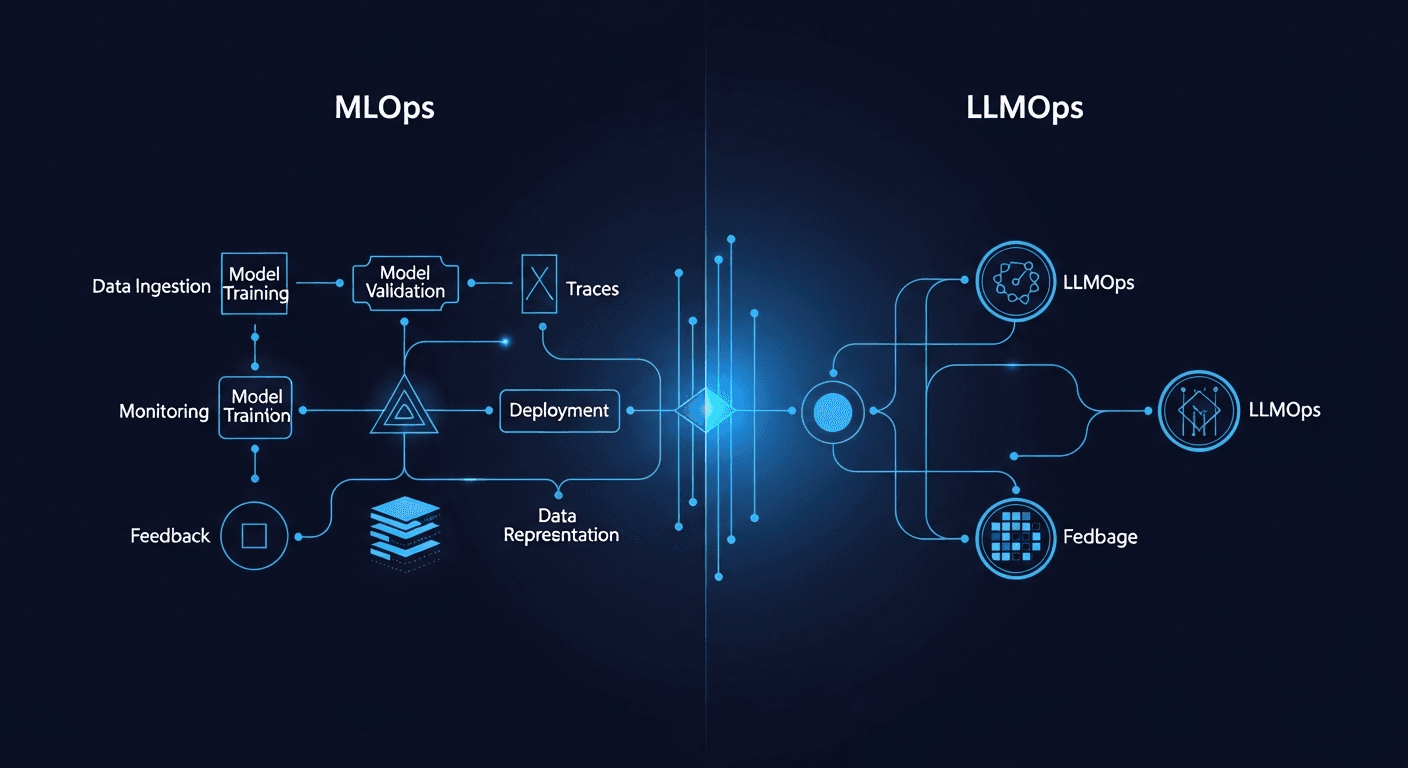
If you already run machine learning in production, MLOps vs LLMOps comes down to this: MLOps is the discipline of deploying, monitoring, and retraining models you train on your own data, while LLMOps adapts those practices to large language models you mostly consume rather than train. The core lifecycle stages overlap, but the failure modes, cost drivers, and quality controls are different enough that treating an LLM application like a classical ML model will cause you problems in production.
This post breaks down where the two practices align, where they diverge, and what your team needs to add when you move from predictive models to generative ones.
The Shared Foundation
Before the differences, it helps to be clear about what carries over. Both MLOps and LLMOps exist to make AI systems reliable, repeatable, and observable in production. Both inherit the same engineering hygiene:
- Version control for code, configuration, and artifacts.
- CI/CD pipelines that test and promote changes through environments.
- Observability: logging, metrics, tracing, alerting.
- Reproducibility: the ability to recreate a result from a known input and a known system state.
- Governance: access control, audit trails, and approval gates.
If your organization has not solved these for classical ML, adopting LLMs will not be easier. The generative layer sits on top of solid operational practice, not instead of it.
MLOps vs LLMOps: The Core Differences
The cleanest way to compare them is by lifecycle stage. Here is where the workflows split.
1. Model creation: training vs. adapting
In traditional MLOps, you own the model. You collect labeled data, engineer features, train, validate, and tune. The model's behavior is a direct function of your dataset and your training run.
In LLMOps, you rarely train the base model. The base model is a foundation model accessed through an API or self-hosted weights. Your job is to adapt its behavior through:
- Prompt engineering: structuring instructions, examples, and context.
- Retrieval-augmented generation (RAG): injecting relevant documents at inference time.
- Fine-tuning or adapters (LoRA, QLoRA) when prompting is insufficient.
This shifts the artifact you version. In MLOps you version a model binary. In LLMOps you also version prompts, retrieval configurations, and the chunks of data feeding the context window.
# Example: a versioned prompt artifact in LLMOps
prompt_id: support-triage-v4
model: gpt-class-foundation-model
temperature: 0.2
system: |
  You are a support triage assistant. Classify the ticket into
  one of: billing, technical, account, other. Return JSON only.
retrieval:
  index: kb-support-2024q4
  top_k: 5
eval_suite: support-triage-eval-v4
That prompt is now a deployable artifact. It needs review, testing, and rollback just like code.
2. Evaluation: deterministic metrics vs. judgment
This is the largest practical difference.
Classical ML evaluation is mostly deterministic. You hold out a test set and compute accuracy, precision, recall, F1, AUC, RMSE. The same input produces the same prediction, and a single number tells you whether a model improved.
LLM outputs are generative, often non-deterministic, and frequently open-ended. There is no single ground-truth label for "summarize this contract." Evaluation in LLMOps requires a richer toolkit:
- Reference-based metrics (BLEU, ROUGE, exact match) for constrained tasks.
- LLM-as-judge: using a strong model to score outputs against a rubric.
- Human evaluation for high-stakes or subjective tasks.
- Task-specific checks: JSON schema validation, factuality checks against retrieved sources, toxicity and safety filters.
You also need regression eval suites that run on every prompt or model change. A small wording change in a prompt can shift behavior across thousands of cases. Without an automated eval gate, you ship regressions blind.
# Minimal eval gate: fail the build if pass rate drops below threshold
results = run_eval_suite("support-triage-eval-v4", prompt="support-triage-v4")
pass_rate = results.passed / results.total

THRESHOLD = 0.92
assert pass_rate >= THRESHOLD, (
    f"Eval regression: {pass_rate:.2%} below {THRESHOLD:.0%}"
)
3. Cost and performance profile
Classical models are usually cheap at inference. Cost lives in training and retraining cycles. A deployed gradient-boosted model serving predictions costs fractions of a cent and responds in milliseconds.
LLMs invert this. Training cost is somebody else's problem if you use a foundation model, but inference is expensive and slow. Cost scales with tokens, and latency is measured in seconds, not milliseconds. This forces operational concerns that MLOps teams rarely think about:
- Token accounting per request and per tenant.
- Caching of prompts and responses to avoid repeated calls.
- Routing between cheaper and more capable models based on task difficulty.
- Streaming responses to manage perceived latency.
- Context window management, because longer context means higher cost and sometimes worse results.
Budget forecasting changes too. With LLMs, a sudden spike in usage is a direct, near-linear spike in spend.
4. Monitoring: drift vs. behavior
MLOps monitoring centers on data drift and concept drift: the statistical distribution of inputs or the input-output relationship shifts over time, degrading accuracy. You watch feature distributions and prediction distributions.
LLMOps monitoring adds new dimensions:
- Hallucination and factuality: is the model inventing content not grounded in the source?
- Prompt injection and jailbreaks: adversarial inputs that subvert instructions.
- Output safety: toxicity, PII leakage, policy violations.
- Quality drift from upstream changes: a provider can update the underlying model behind the same API endpoint, changing behavior without any change on your side.
That last point deserves emphasis. In MLOps, the model is frozen unless you retrain it. In LLMOps, your dependency can change beneath you. Pinning model versions and running continuous evals is how you detect this.
A Side-by-Side Summary
| Dimension | MLOps | LLMOps |
|---|---|---|
| Primary artifact | Trained model binary | Prompts, RAG config, optionally adapters |
| Model ownership | You train it | You adapt a foundation model |
| Evaluation | Deterministic metrics | LLM-as-judge, human review, schema checks |
| Inference cost | Low, milliseconds | High, token-based, seconds |
| Key monitoring risk | Data and concept drift | Hallucination, injection, upstream model changes |
| Retraining trigger | Drift or new data | Prompt change, eval regression, provider update |
What This Means for Your Team
The takeaway is not that you replace MLOps with LLMOps. Most production AI organizations run both. A fraud model and a customer support assistant live in the same company and demand different operational treatment.
Practical recommendations:
- Keep your MLOps foundation. CI/CD, versioning, and observability are prerequisites, not options.
- Treat prompts as code. Version them, review them, test them, and gate deploys on eval results.
- Build an eval suite before you scale. Manual spot-checking does not survive contact with production volume.
- Pin model versions and alert on behavior changes you did not cause.
- Instrument cost from day one. Token-level visibility prevents budget surprises.
- Add a safety layer for input validation and output filtering, especially for user-facing applications.
If you are mapping these practices onto a real delivery plan, our data, AI, and MLOps capabilities describe how this lifecycle gets implemented end to end. And because the right controls depend heavily on your domain, it is worth looking at how requirements differ across the industries we work with, where regulated sectors carry stricter evaluation and audit demands than consumer products.
Common Pitfalls When Moving from MLOps to LLMOps
- Skipping evaluation because outputs "look good." Demos are not evidence. You need measured pass rates on representative cases.
- Ignoring non-determinism. Setting temperature to zero reduces variance but does not eliminate it. Design tests that tolerate acceptable variation.
- Underestimating retrieval quality. In RAG systems, most quality problems trace back to retrieval, not the model. Monitor retrieval relevance separately.
- Treating cost as fixed. Token usage grows with prompt complexity and context size. Review it as you would any cloud spend line.
Generative AI does not retire the operational discipline you built for predictive models. It extends it. The teams that succeed in production are the ones that respect that continuity while building the new evaluation, cost, and safety controls that LLMs require.
Built in Lagos, shipped from everywhere.
FAQ
Is LLMOps just MLOps with a different name?
No. LLMOps reuses the operational backbone of MLOps, including CI/CD, versioning, and monitoring, but adds practices specific to generative models: prompt management, retrieval pipelines, non-deterministic evaluation, token-based cost control, and safety filtering. The lifecycle stages rhyme, but the artifacts and failure modes differ.
Do I need both MLOps and LLMOps?
Most production AI teams do. Predictive use cases like forecasting, classification, and ranking are well served by classical MLOps. Generative use cases like assistants, summarization, and document Q&A need LLMOps controls. They coexist in the same organization and often the same platform.
Why is evaluation harder for LLMs?
Classical models produce deterministic outputs you can score against labeled ground truth. LLM outputs are generative and often open-ended, so there may be many acceptable answers. Evaluation relies on a mix of reference-based metrics, LLM-as-judge scoring, schema validation, and human review, run as automated regression suites on every change.
How do upstream model updates affect production LLM systems?
When you use a hosted foundation model, the provider can change the underlying model behind the same endpoint. Behavior can shift without any change on your side. Pin model versions where possible and run continuous evaluation so you detect quality drift quickly.
What is the biggest cost difference between MLOps and LLMOps?
In MLOps, cost concentrates in training and retraining, while inference is cheap. In LLMOps, training is usually outsourced to the foundation model provider, but inference is expensive and scales with token usage. Plan for token accounting, caching, and model routing to keep spend predictable.