What are the Key Pillars of an Agile Enterprise Architecture?
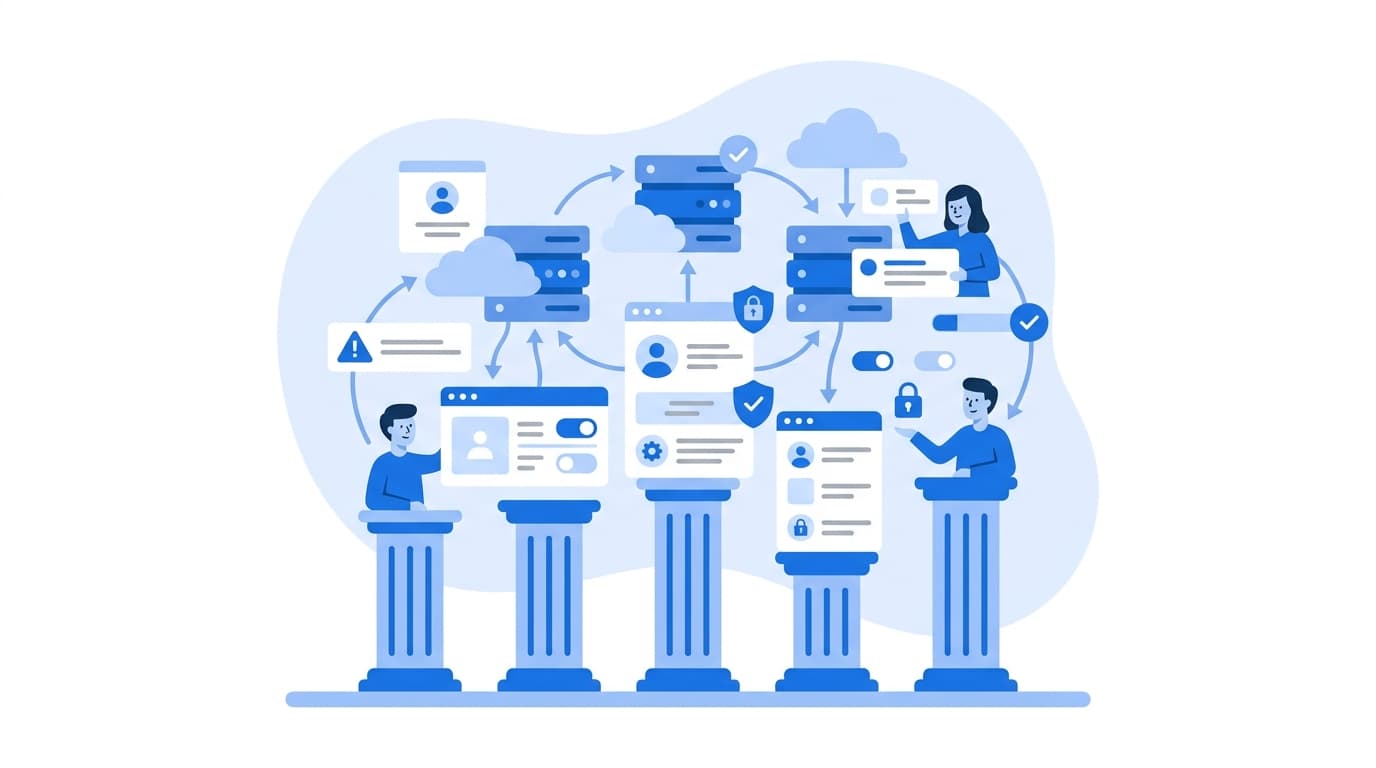
An agile enterprise architecture rests on six pillars: business capability alignment, modular and loosely coupled systems, guardrail-based governance, team structures that mirror the architecture, evolutionary change backed by automated checks, and continuous feedback through outcome metrics. Together, these let an organization change direction without rewriting its foundations. The rest of this post explains each pillar, shows what it looks like in practice, and covers the trade-offs we see when teams adopt them.
The Problem: Architecture That Can't Keep Up
Most enterprise architects we talk to aren't short on frameworks. They're short on time. A product team needs a decision this sprint, and the architecture review board meets next month. A strategic initiative requires a new data flow, but the integration landscape is so tightly wired that every change triggers a regression cycle across five systems.
The traditional response is more documentation and more review gates. The result is usually the opposite of what was intended. Teams route around the architecture function, and the "official" architecture drifts further from what's actually running in production.
The goal of agile enterprise architecture is not to abandon structure. It is to put structure where it creates business agility, and to remove it where it only creates delay.
Pillar 1: Business Capability Alignment
Architecture should be organized around what the business does, not around which systems happen to exist today. A business capability map describes stable functions such as "Manage Customer Identity," "Price Products," and "Fulfill Orders," independent of org charts or vendors.
Why this matters for agility:
- Capabilities change slowly; systems change quickly. Anchoring decisions to capabilities gives you a stable reference point while the technology underneath evolves.
- Investment becomes traceable. You can tie a digital transformation roadmap to specific capabilities rather than to abstract "platform modernization."
- Overlap becomes visible. Three systems serving one capability is a consolidation candidate. Zero systems serving a strategic capability is a gap.
We find it useful to keep capability maps in version control alongside other architecture artifacts, so they're reviewed and updated like code:
capability: fulfill-orders
level: 1
strategic_importance: differentiating
owner_team: fulfillment-platform
children:
  - capability: allocate-inventory
    systems: [inventory-service]
  - capability: schedule-shipment
    systems: [shipping-service, legacy-wms]
    notes: "legacy-wms retirement planned; see ADR-0042"
Pillar 2: Modular, Loosely Coupled Systems
You can't move quickly if every change ripples across the estate. Modularity is the technical precondition for agility.
Domain boundaries first
Domain-Driven Design (Eric Evans, Domain-Driven Design, 2003) gives a practical vocabulary here: bounded contexts define where a model applies and where it stops. Aligning service or module boundaries to bounded contexts, which often map cleanly to the capabilities from Pillar 1, keeps changes local.
Contracts over shared databases
Loose coupling depends on explicit interfaces:
- Versioned APIs and event schemas instead of direct database access across teams
- Asynchronous events where consumers don't need an immediate response
- Consumer-driven contract tests so providers know when they're about to break someone
Note that modularity doesn't mandate microservices. A well-structured modular monolith with enforced internal boundaries often delivers most of the benefit at a fraction of the operational cost. The pillar is decoupling, not a particular deployment topology.
Pillar 3: Guardrail-Based Governance
Traditional governance asks teams to request permission. Agile governance tells teams the boundaries up front and lets them decide within those boundaries.
Principles and guardrails, not approvals
A short set of architecture principles (for example, "Data leaving a bounded context goes through a published contract") does more work than a long review checklist. Guardrails turn principles into enforceable defaults: approved platform patterns, golden-path templates, and policy-as-code.
Decisions recorded where engineers work
Architecture Decision Records (ADRs), described by Michael Nygard in his 2011 post "Documenting Architecture Decisions," capture the context and consequences of significant choices in a lightweight format. Storing them in the repository makes them discoverable and reviewable through normal pull-request workflows:
# ADR-0042: Replace legacy WMS shipment scheduling with shipping-service

## Status
Accepted

## Context
The legacy WMS couples shipment scheduling to inventory batch jobs,
delaying same-day fulfillment changes.

## Decision
Route all new shipment scheduling through shipping-service via the
`ShipmentRequested` event. Legacy WMS becomes read-only for scheduling.

## Consequences
- Fulfillment team owns the migration of in-flight orders.
- Reporting must switch to the new event stream within two releases.
This is where an enterprise architecture framework such as TOGAF (published by The Open Group) remains valuable: as a reference for what to consider. The agile adaptation is in how decisions get made: closer to the teams, faster, and with a clear audit trail.
Pillar 4: Teams Shaped Like the Architecture
Melvin Conway observed in 1968 that organizations design systems that mirror their communication structures. Teams can work with this principle or fight it.
Team Topologies (Matthew Skelton and Manuel Pais, 2019) offers a practical model:
- Stream-aligned teams own a slice of business value end to end, ideally a capability or bounded context.
- Platform teams provide self-service infrastructure so stream-aligned teams don't rebuild the basics.
- Enabling teams help others adopt new practices, then step away.
- Complicated-subsystem teams own components that require deep specialist knowledge.
For enterprise architects, this means the architecture role shifts. Instead of acting as a central design authority, architects operate as an enabling function: they shape boundaries, facilitate cross-team decisions, and maintain the guardrails.
Pillar 5: Evolutionary Change with Fitness Functions
An agile enterprise architecture treats the target state as a direction, not a fixed blueprint. Building Evolutionary Architectures (Neal Ford, Rebecca Parsons, and Patrick Kua, 2017) introduced architectural fitness functions: automated checks that verify an architectural characteristic still holds as the system changes.
Fitness functions turn principles into tests that run in CI. For example, using ArchUnit in a Java codebase to enforce that domain logic never depends on infrastructure:
@AnalyzeClasses(packages = "com.example.orders")
public class ArchitectureRulesTest {

    @ArchTest
    static final ArchRule domainIsIndependentOfInfrastructure =
        noClasses().that().resideInAPackage("..domain..")
            .should().dependOnClassesThat()
            .resideInAPackage("..infrastructure..");
}
Other useful fitness functions include:
- Latency or throughput thresholds checked in performance test stages
- Dependency rules that block new direct calls into deprecated systems
- Security policies enforced through infrastructure-as-code scanning
- Schema compatibility checks on event contracts before publishing
The payoff is that architectural intent survives contact with daily delivery. Drift gets caught in a pipeline, not in an annual review.
Pillar 6: Continuous Feedback Through Outcome Metrics
Architecture decisions are hypotheses about what will help the business move faster or more safely. You need evidence to know whether they're working.
The four key metrics popularized by the DORA research program and the book Accelerate (Nicole Forsgren, Jez Humble, and Gene Kim, 2018) are a sensible starting point:
- Deployment frequency
- Lead time for changes
- Change failure rate
- Time to restore service
Pair these with architecture-specific signals: the number of teams required to ship a typical feature, the count of cross-team dependencies per release, or the share of capabilities still served by systems slated for retirement. Track trends, not targets. A metric that becomes a target tends to get gamed.
Bringing the Pillars Into Your IT Strategy
These pillars reinforce each other. Capability maps define boundaries, boundaries shape teams, guardrails and fitness functions protect the boundaries, and metrics tell you whether the whole system is getting faster. Implementing one pillar in isolation usually disappoints: modular services owned by functionally siloed teams still require heavy coordination.
A practical sequence we recommend:
- Map capabilities for one business domain, not the whole enterprise.
- Identify the biggest coupling pain in that domain and decouple it.
- Introduce ADRs and two or three fitness functions for the new boundaries.
- Align team ownership to those boundaries.
- Baseline delivery metrics, then review quarterly and expand to the next domain.
This incremental approach keeps your IT strategy grounded in measurable progress rather than a multi-year redesign. Context matters too: constraints in regulated sectors differ from those in fast-moving consumer businesses, and you can see how these patterns apply across the industries we work with. If you're assessing where to start, our overview of engineering and advisory capabilities outlines the kinds of architecture and delivery work involved.
FAQ
What is agile enterprise architecture?
Agile enterprise architecture is an approach that applies agile principles (incremental change, fast feedback, and decentralized decision-making) to enterprise-wide architecture. It keeps strategic alignment and governance but replaces heavy upfront design and approval gates with guardrails, lightweight decision records, and automated checks.
Does agile enterprise architecture replace frameworks like TOGAF?
Not necessarily. Frameworks such as TOGAF provide useful structure for what an architecture practice should consider. Agile approaches change how that structure is applied: shorter cycles, decisions made closer to delivery teams, and governance enforced through automation where possible.
How does enterprise architecture support business agility?
It supports business agility by organizing systems and teams around stable business capabilities, reducing coupling so changes stay local, and making architectural constraints explicit and automated. This lets teams respond to new requirements without coordinating across the entire organization.
Do we need microservices to have an agile enterprise architecture?
No. The underlying requirement is loose coupling with clear boundaries and contracts. A modular monolith with enforced internal boundaries can meet that requirement, often with lower operational overhead. Choose the deployment model based on scaling, team, and operational needs.
Where should an organization start?
Start small. Pick one business domain, map its capabilities, address its most painful coupling point, and introduce ADRs and a few fitness functions. Measure delivery outcomes before and after, then expand based on what you learn.