Platform Engineering's Role in Building Resilient 24/7 SRE Pipelines for Kubernetes
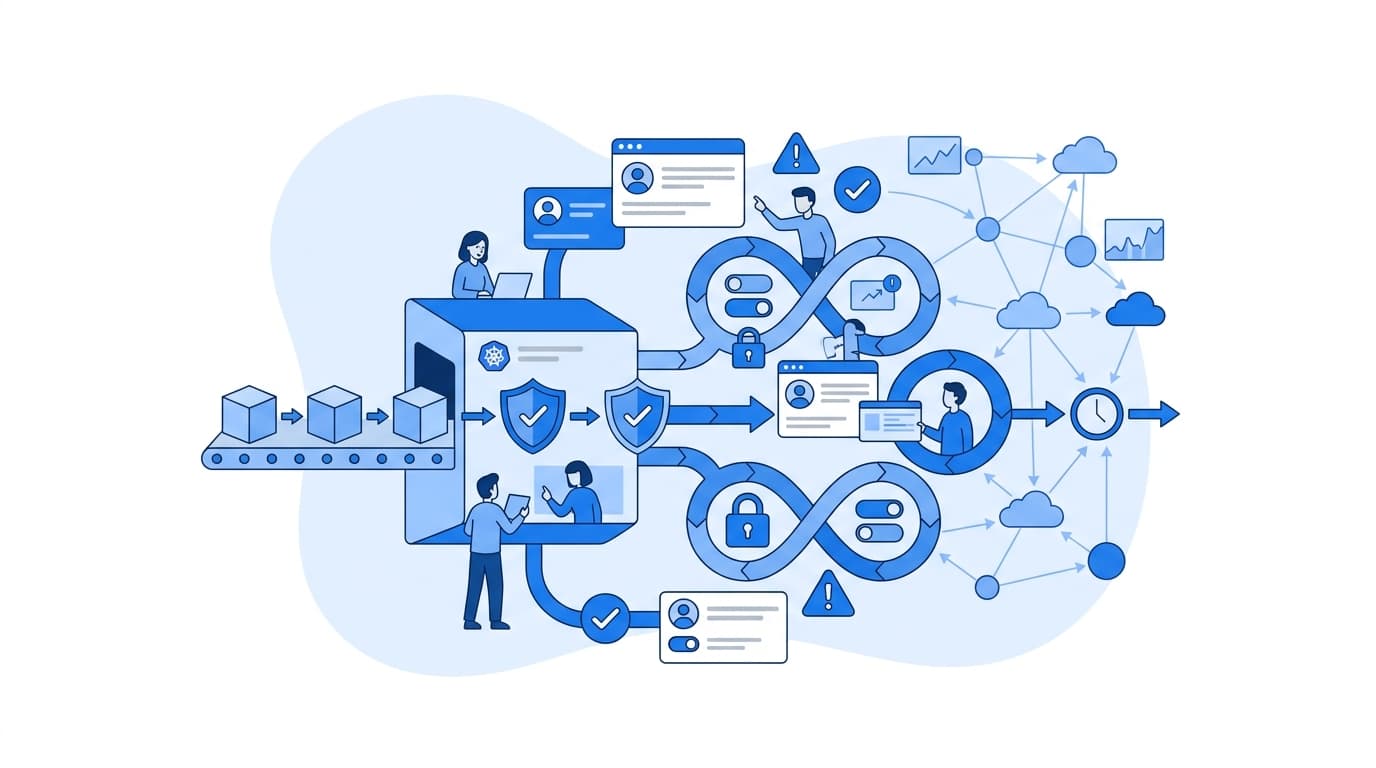
Platform Engineering SRE is the practice of building an internal platform that bakes reliability into every Kubernetes deployment by default. Instead of each team assembling its own monitoring, alerting, rollout strategy, and on-call tooling, the platform team provides paved, self-service paths where those concerns are already solved. Site reliability engineers then spend their time on service level objectives, incident response, and systemic improvements rather than on repetitive setup work. For organizations running Kubernetes around the clock, this pairing is often what makes 24/7 SRE operations sustainable for the people who carry the pager.
The rest of this post explains what that looks like in practice, which building blocks matter most, and how we suggest teams get started.
What Platform Engineering SRE Actually Means
The two disciplines have different origins but complementary goals.
- Site Reliability Engineering, as described in Google's Site Reliability Engineering book (Beyer et al., O'Reilly, 2016), treats operations as a software problem. It introduced concepts like error budgets, toil reduction, and blameless postmortems.
- Platform engineering, as framed in the CNCF TAG App Delivery Platforms White Paper (2023), focuses on building internal platforms that give application teams consistent, self-service capabilities with a good developer experience.
When you combine them, the platform becomes the delivery mechanism for reliability practices. An SLO is no longer a document someone writes once. It is a resource a team declares, and the platform generates the alerts, dashboards, and burn-rate tracking from it.
Team Topologies (Skelton and Pais, 2019) offers a useful lens here. The platform team exists to reduce the cognitive load on stream-aligned teams. Reliability tooling is one of the heaviest sources of that load, which makes it a natural candidate for the platform.
Why 24/7 SRE Breaks Down Without a Platform
In our experience, round-the-clock Kubernetes operations tend to fail in predictable ways when there is no shared platform:
- Inconsistent instrumentation. Each service exposes metrics differently, so on-call engineers waste the first fifteen minutes of an incident figuring out where to look.
- Alert fatigue. Teams alert on CPU, memory, and pod restarts instead of user-facing symptoms. Pages fire at 3 a.m. for conditions that do not affect customers.
- Unsafe rollouts. Without standardized progressive delivery, a bad release reaches every user before anyone notices.
- Tribal knowledge. Runbooks live in wikis that drift out of date, and only a few people know how certain clusters really behave.
- Toil accumulation. The SRE book recommends keeping operational toil below 50 percent of an SRE's time. Without automation, that ceiling is easy to breach.
None of these are failures of individual engineers. They are structural problems, and structural problems need platform-level solutions.
The Building Blocks of Resilient Kubernetes SRE Pipelines
Golden Paths With Reliability Defaults
A golden path is an opinionated, supported way to build and ship a service. For reliability, the template should include readiness and liveness probes, resource requests, a PodDisruptionBudget, standard metric endpoints, and structured logging from day one.
A PodDisruptionBudget is a small example of a default that prevents real outages during node drains and cluster upgrades:
apiVersion: policy/v1
kind: PodDisruptionBudget
metadata:
  name: checkout-pdb
spec:
  minAvailable: 2
  selector:
    matchLabels:
      app: checkout
When the platform template generates this automatically, no team has to remember it.
Policy as Code as Guardrails
Defaults help, but guardrails make them durable. Admission controllers such as Kyverno or OPA Gatekeeper can reject workloads that would undermine cluster stability. This Kyverno policy, adapted from the project's published samples, blocks pods without CPU and memory requests:
apiVersion: kyverno.io/v1
kind: ClusterPolicy
metadata:
  name: require-requests
spec:
  validationFailureAction: Enforce
  rules:
    - name: validate-resources
      match:
        any:
          - resources:
              kinds:
                - Pod
      validate:
        message: "CPU and memory requests are required."
        pattern:
          spec:
            containers:
              - resources:
                  requests:
                    memory: "?*"
                    cpu: "?*"
We recommend starting policies in Audit mode, reviewing violations with teams, and moving to Enforce once the golden path makes compliance effortless.
SLOs as a Platform Primitive
This is where Platform Engineering SRE pays off most directly. The Site Reliability Workbook (Beyer et al., 2018) recommends multi-window, multi-burn-rate alerting: page when the error budget is being consumed fast enough to matter, and confirm with a short window so the alert resets quickly after recovery.
For a 99.9 percent availability SLO, a burn rate of 14.4 over one hour consumes about 2 percent of a 30-day budget. A Prometheus rule might look like this:
groups:
  - name: checkout-slo
    rules:
      - alert: CheckoutErrorBudgetFastBurn
        expr: |
          (
            sum(rate(http_requests_total{job="checkout",code=~"5.."}[1h]))
            /
            sum(rate(http_requests_total{job="checkout"}[1h]))
          ) > (14.4 * 0.001)
          and
          (
            sum(rate(http_requests_total{job="checkout",code=~"5.."}[5m]))
            /
            sum(rate(http_requests_total{job="checkout"}[5m]))
          ) > (14.4 * 0.001)
        labels:
          severity: page
        annotations:
          summary: "Checkout is burning error budget at 14.4x"
          runbook_url: "https://runbooks.internal/checkout/error-budget"
Writing this by hand for every service does not scale. Tools like Sloth or Pyrra let a team declare an SLO in a few lines and generate these rules automatically. The platform should own that generator so every service gets consistent, symptom-based alerting.
Progressive Delivery and Automated Rollback
Canary and blue-green deployments limit the blast radius of a bad change. Argo Rollouts and Flagger both integrate with Prometheus so a rollout can be paused or reversed automatically when error rates or latency degrade. Paired with GitOps tooling such as Argo CD or Flux, every change becomes auditable and reversible through version control.
Observability by Default
OpenTelemetry has become the common standard for traces, metrics, and logs. When the platform injects collectors and standard resource attributes, on-call engineers can move from an alert to a trace to the relevant logs without hunting across tools.
Designing for 24/7 SRE Operations: People and Process
Tooling alone does not make round-the-clock operations humane. The platform should also support the human side.
On-Call Ergonomics
- Route alerts by ownership. Use labels from the service catalog so pages reach the team that owns the service.
- Separate pages from tickets. Only symptoms that threaten the SLO should wake someone up. Everything else goes to a queue.
- Consider follow-the-sun rotations if your team spans time zones, so nobody routinely handles overnight pages.
Runbooks as Code
Store runbooks alongside service code and link them in every alert annotation, as in the example above. Where a runbook step is purely mechanical, automate it. A runbook that says "restart the pod and check the queue depth" is a candidate for a Kubernetes operator or a scripted remediation.
The Incident Learning Loop
Blameless postmortems, as described in the SRE book, should produce action items that feed back into the platform. If an incident happened because a team skipped a PDB, the fix is a policy or a template change, not a reminder email. This loop is how the platform gets more resilient over time.
Dividing Responsibilities Clearly
Ambiguity about ownership is a common source of slow incident response. A clear split we have found effective:
- Platform team: clusters, golden paths, policy engine, observability pipeline, SLO tooling, CI/CD and GitOps infrastructure.
- SRE function: SLO definitions with product owners, error budget policy, incident command, postmortem facilitation, reliability reviews for new services.
- Stream-aligned teams: service code, service-level SLO targets, on-call for their own services using platform-provided tooling.
Some organizations merge platform and SRE into one group. That can work well at smaller scale, as long as the team protects time for platform development and does not get consumed by tickets.
Where to Start
You do not need to build everything at once. A sequence we suggest:
- Pick one critical, user-facing service and define two or three SLOs with its owners.
- Implement burn-rate alerting for that service and retire the noisy resource-based pages.
- Codify the service's setup into a template, including probes, requests, PDB, and telemetry.
- Add admission policies in audit mode to see how far other workloads drift from that template.
- Introduce progressive delivery for the pilot service, with automated rollback tied to SLO metrics.
- Expand service by service, measuring progress with the DORA metrics (deployment frequency, lead time for changes, change failure rate, and time to restore service) described in the Accelerate research by Forsgren, Humble, and Kim.
If your team is weighing whether to build this capability internally or with outside help, our overview of cloud and platform engineering capabilities describes how we approach these engagements. Reliability requirements also vary by sector, particularly around compliance and uptime expectations, so it is worth reviewing how these patterns apply across regulated and high-availability industries.
FAQ
What is the difference between platform engineering and SRE?
Platform engineering builds internal products, such as deployment pipelines, templates, and observability stacks, that application teams use on a self-service basis. SRE focuses on the reliability of production services through SLOs, error budgets, incident response, and toil reduction. In a Platform Engineering SRE model, the platform delivers reliability practices as built-in features.
Do small teams need a dedicated platform team for Kubernetes SRE pipelines?
Not necessarily. A small group can start with a few shared templates, a single SLO tool, and a standard alerting configuration maintained by whoever owns the clusters. The key is treating that shared tooling as a product with clear ownership, even if it is a part-time responsibility at first.
Which SLOs should we define first?
Start with what users notice: availability and latency for the most important request paths. The SRE Workbook recommends a small number of SLOs per service, based on user-facing indicators rather than internal resource metrics like CPU usage.
How does a platform reduce on-call burden in 24/7 SRE operations?
It replaces cause-based alerts with symptom-based, burn-rate alerts, links every page to a runbook, and automates common remediations. It also prevents whole classes of incidents through guardrails such as admission policies and progressive delivery, which means fewer pages to begin with.
Is GitOps required for resilient infrastructure on Kubernetes?
It is not strictly required, but it helps significantly. GitOps makes the desired state of every cluster auditable and reversible through version control, which shortens recovery time and simplifies change review during incidents.