MLOps vs. LLMOps: Key Differences in Production AI Workflows
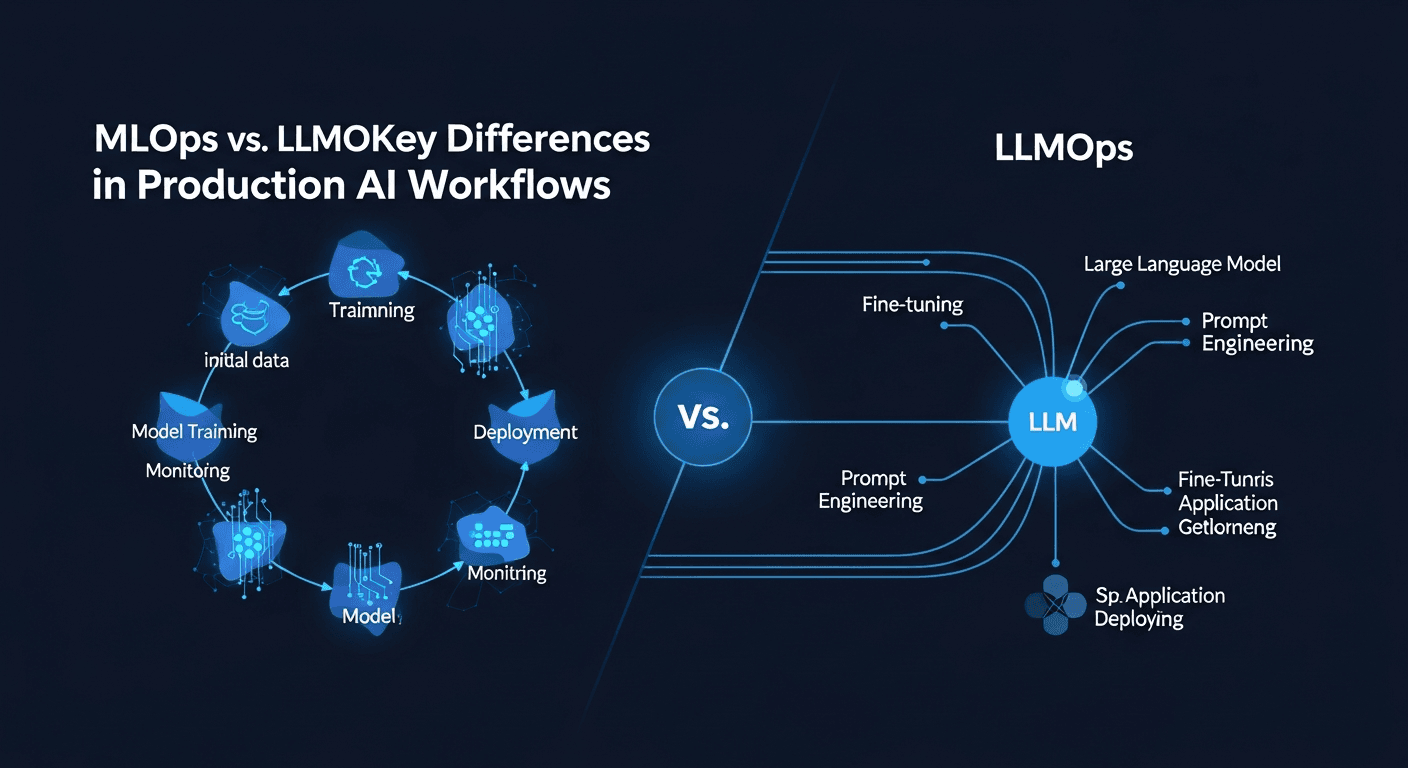
If you have shipped traditional machine learning models to production and are now wrestling with large language models, the short answer to MLOps vs LLMOps is this: the lifecycle stages look familiar, but the failure modes, cost drivers, and evaluation methods are fundamentally different. MLOps assumes you train a model on your data, version it, and serve deterministic-ish predictions. LLMOps assumes you are mostly orchestrating, prompting, and constraining a model you did not train, while managing non-deterministic outputs, prompt versions, retrieval pipelines, and per-token costs that scale with usage.
This post breaks down where the two disciplines overlap, where they diverge, and how to adapt your existing engineering practices without throwing them away.
MLOps vs LLMOps: The Core Distinction
MLOps and LLMOps both aim for the same outcome: reliable, observable, repeatable AI in production. The divergence comes from what you control.
In classic MLOps, you own the model weights. You curate the training set, run feature engineering, train and validate, then deploy an artifact whose behavior is fixed until you retrain. Your hardest problems are data drift, feature pipelines, and reproducibility.
In LLMOps, you usually consume a foundation model through an API or host an open-weight model you rarely fine-tune from scratch. The "code" that shapes behavior is now spread across prompts, retrieval context, tool definitions, and system instructions. Your hardest problems are prompt regression, hallucination, context management, latency, and cost per request.
Here is the practical contrast:
| Concern | MLOps | LLMOps |
|---|---|---|
| Primary artifact | Trained model weights | Prompts, chains, retrieval config, optional fine-tunes |
| Iteration unit | Retraining run | Prompt or pipeline change |
| Evaluation | Accuracy, F1, AUC | Faithfulness, relevance, safety, human preference |
| Determinism | Mostly deterministic | Non-deterministic by default |
| Cost driver | Training compute | Inference tokens, context length |
| Drift type | Data/feature drift | Behavior drift, model deprecation |
What Stays the Same
It is easy to overstate the differences. A lot of disciplined MLOps practice carries directly into LLMOps.
- Versioning everything. You still need version control for code, configuration, and the artifacts that define behavior. The artifact is just a prompt template or chain definition instead of a
.pklfile. - CI/CD pipelines. Automated testing and deployment gates apply to both. The tests change, not the principle.
- Observability. You still need structured logging, tracing, and alerting in production.
- Environment parity. Staging that mirrors production is as important as ever.
- Governance and access control. Who can deploy, who can read sensitive logs, and how you audit changes are unchanged concerns.
If your organization has mature MLOps, you are not starting from zero. You are extending the pipeline to handle new artifacts and new evaluation signals.
Where LLMOps Diverges
1. Prompts are code, and they regress
In a traditional MLOps lifecycle, a code change is the unit of risk. In LLMOps, a single word change in a system prompt can shift output quality across thousands of cases. Treat prompts as versioned, tested artifacts.
# prompt_registry/summarize_ticket_v3.yaml
id: summarize_ticket
version: 3
model: gpt-4o-mini
temperature: 0.2
system: |
  You are a support triage assistant. Summarize the ticket in
  three bullet points. Do not invent details not present in the input.
  If information is missing, state "not provided".
eval_suite: summarize_ticket_goldens
Pinning the model name and parameters in the same artifact matters, because a provider silently upgrading a model is its own form of drift.
2. Evaluation is multidimensional and partly subjective
You cannot reduce LLM quality to one accuracy number. You need a layered approach:
- Deterministic checks. Does the output parse as valid JSON? Does it contain required fields? Is it under the length limit?
- Reference-based metrics. For tasks with known answers, compare against golden outputs.
- LLM-as-judge. Use a separate model to score faithfulness, relevance, and tone against a rubric. Useful, but validate the judge against human labels before trusting it.
- Human review. Sample production traffic for periodic human evaluation, especially for high-stakes domains.
def evaluate_response(output: str, context: str) -> dict:
    return {
        "valid_json": is_valid_json(output),
        "grounded": llm_judge_faithfulness(output, context),  # 0-1
        "no_pii_leak": pii_scan(output) == [],
        "within_length": len(output) <= 2000,
    }
Gate deployments on these scores the way you would gate on unit tests.
3. Retrieval becomes a first-class pipeline
Most production LLM systems use retrieval-augmented generation (RAG). That introduces a data pipeline that lives alongside the model and needs its own operational discipline:
- Chunking and embedding strategy, versioned like a feature pipeline.
- Index freshness. Stale documents produce confidently wrong answers.
- Retrieval quality metrics. Track recall and precision of retrieved chunks independently of final answer quality, so you can isolate whether a failure is retrieval or generation.
When a RAG system regresses, the cause is often the index, not the prompt. Without separate retrieval metrics you will waste days tuning prompts that were never the problem.
4. Cost and latency are runtime concerns, not training concerns
In MLOps, your big cost spike is training. In LLMOps, cost is continuous and proportional to traffic and context size. Practical controls:
- Token budgets per request with hard caps.
- Model routing. Send simple requests to a smaller, cheaper model and escalate only when needed.
- Caching. Cache responses for repeated or semantically similar queries.
- Context trimming. Long context is convenient and expensive. Retrieve the minimum that answers the question.
def route_model(query: str) -> str:
    if estimated_complexity(query) < THRESHOLD:
        return "small-fast-model"
    return "large-capable-model"
5. New safety and security surfaces
LLMs introduce risks that have no clean MLOps analog:
- Prompt injection, where untrusted input overrides your instructions. The OWASP Top 10 for LLM Applications documents this as the leading risk class (owasp.org/www-project-top-10-for-large-language-model-applications).
- Sensitive data leakage into prompts and logs.
- Output handling, where downstream systems execute or trust model output without validation.
Treat model output as untrusted user input. Validate, sanitize, and constrain before it touches another system.
Adapting Your Lifecycle
Here is how the MLOps lifecycle maps onto LLMOps in practice. The stages persist; the content changes.
| Stage | MLOps focus | LLMOps focus |
|---|---|---|
| Develop | Feature engineering, training | Prompt design, chain composition, RAG setup |
| Test | Validation set metrics | Eval suites, LLM-as-judge, red-teaming |
| Deploy | Model serving | Prompt + config rollout, model pinning |
| Monitor | Data/concept drift | Behavior drift, cost, latency, hallucination rate |
| Improve | Retrain | Refine prompts, update index, fine-tune if justified |
A few principles tie this together:
- Roll out gradually. Use canary releases for prompt and model changes. Compare quality and cost against the current version before full rollout.
- Log inputs and outputs responsibly. You need traces to debug non-deterministic behavior, but logs may contain sensitive data. Redact at capture time.
- Track behavior drift explicitly. Sample production outputs and re-run your eval suite on them. A model provider update or a shift in user inputs can degrade quality with no code change on your side.
- Decide deliberately between prompting, RAG, and fine-tuning. Most teams reach for fine-tuning too early. Prompting and retrieval solve more problems, faster and cheaper, than people expect.
If you are evaluating how to operationalize either workflow across your stack, our Data, AI & MLOps capabilities outline how we approach pipeline design, evaluation, and production hardening. The right pattern also depends heavily on your domain, which is why we tailor approaches by the industries we serve, from regulated sectors with strict data handling to high-throughput consumer products.
A Decision Heuristic
When a stakeholder asks whether to "do MLOps or LLMOps," reframe it:
- If you are training models on proprietary data and serving predictions, you are doing MLOps.
- If you are orchestrating foundation models with prompts, retrieval, and tools, you are doing LLMOps.
- Many production systems do both: a classic model for ranking or scoring feeding context into an LLM for generation. In that case, run both lifecycles side by side with shared infrastructure for versioning, CI/CD, and observability.
The goal is not to pick a camp. It is to apply the right operational discipline to each artifact you ship.
FAQ
Is LLMOps just MLOps with a new name?
No. LLMOps inherits MLOps principles like versioning, CI/CD, and observability, but it adds prompt management, non-deterministic evaluation, retrieval pipelines, per-token cost control, and prompt-injection defense. The discipline is an extension of MLOps, not a rebrand of it.
Do I still need to train models if I use LLMOps?
Often no. Most production LLM systems consume foundation models through prompting and retrieval, with fine-tuning reserved for narrow cases where prompting and RAG fall short. Reach for prompting and retrieval first, and treat fine-tuning as a deliberate cost-benefit decision.
How do I evaluate LLM output if there is no single accuracy score?
Use layered evaluation: deterministic checks for format and safety, reference-based metrics where golden answers exist, LLM-as-judge for subjective quality, and periodic human review for high-stakes cases. Gate deployments on these combined signals.
What is the biggest operational risk unique to LLMOps?
Prompt injection and unsafe output handling. Untrusted input can override your instructions, and downstream systems may trust model output blindly. Treat all model output as untrusted and validate it before use, as documented in the OWASP Top 10 for LLM Applications.
Can MLOps and LLMOps share the same infrastructure?
Yes, and they should where possible. Version control, CI/CD pipelines, secrets management, and observability tooling can serve both. What differs is the artifacts, tests, and metrics layered on top of that shared foundation.
Production-grade cloud, software, and engineering teams for scaling companies.