Implementing LLM Guardrails in Production: Strategies for Safety and Alignment
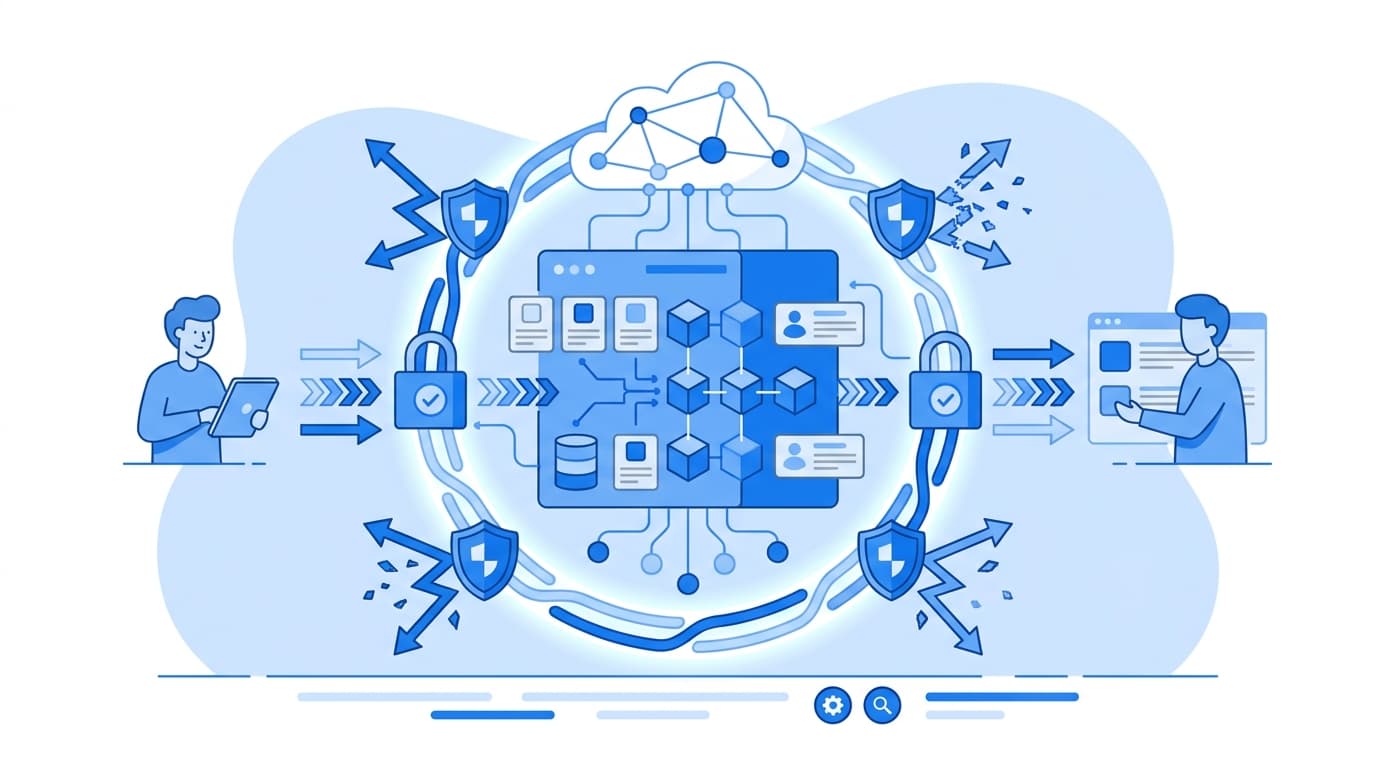
LLM guardrails are the controls that sit around a language model to keep its inputs, outputs, and actions inside defined boundaries. To implement them in production, you build layered, independent checks: validate and sanitize inputs, constrain what the model can see and do, verify outputs against policy and schema before they reach a user or downstream system, and continuously evaluate the whole pipeline with adversarial test sets. No single layer is sufficient. Defense in depth, plus observability, is what makes production LLMs safe enough to ship.
The rest of this post walks through how we approach each layer, with code you can adapt, and the operational practices that keep guardrails effective after launch.
Why a System Prompt Is Not a Guardrail
Most teams start with a carefully worded system prompt: "Never reveal internal data. Refuse off-topic requests." That is a reasonable start, but it is an instruction, not a control. The model interprets it probabilistically, and a sufficiently clever user, or a malicious document pulled in through retrieval, can override it.
The OWASP Top 10 for LLM Applications lists prompt injection as its first risk for exactly this reason. Security researcher Simon Willison has written extensively about why prompt injection resists purely model-based fixes: the model cannot reliably distinguish trusted instructions from untrusted data when both arrive as text.
The practical implication: treat the model as an untrusted component. Your guardrails should work even when the model misbehaves.
A Layered Architecture for LLM Guardrails
We think about guardrails in five layers. Each one catches failures the others miss.
Layer 1: Input Validation
Before a request reaches the model, check it for:
- Prompt injection patterns, using a classifier rather than regex alone
- PII and secrets, which you may need to redact before sending to a third-party model API
- Topic scope, so a customer-support bot is not asked to write malware
- Size and rate limits, to control cost and resist denial-of-wallet attacks
Open-source tools help here. Microsoft Presidio handles PII detection and anonymization. Safety classifiers such as Meta's Llama Guard can label prompts against a configurable hazard taxonomy.
Layer 2: Context and Retrieval Controls
In retrieval-augmented generation (RAG), the documents you inject are an attack surface. Indirect prompt injection happens when retrieved content contains instructions the model then follows.
- Enforce document-level access control at retrieval time, so users only retrieve content they are already authorized to read
- Clearly delimit untrusted content in the prompt and tell the model it is data, not instruction (helpful, though not a hard control)
- Scan ingested documents for injection payloads before indexing
Layer 3: Model-Level Alignment
This is where LLM alignment lives: choosing a model with appropriate safety tuning, writing a precise system prompt, and, where justified, fine-tuning on your domain's refusal and response patterns. Alignment reduces the rate of bad outputs. It does not eliminate them, which is why layers 4 and 5 exist.
Layer 4: Output Validation
Every response should pass checks before it is shown or acted upon:
- Schema validation for structured outputs (JSON, function arguments)
- Policy classification for toxicity, self-harm, or regulated advice
- Grounding checks in RAG systems, verifying claims are supported by retrieved sources
- Data leakage scans for PII, secrets, or system prompt content
Layer 5: Action and Tool Authorization
Agentic systems that call tools carry the highest risk. OWASP calls this "excessive agency." The rule we follow: the model proposes, deterministic code disposes.
- Allow-list the tools and parameters each workflow can use
- Execute tools with the end user's permissions, never a privileged service account
- Require human confirmation for irreversible or high-impact actions (payments, deletions, external emails)
Implementing the Pipeline: A Reference Pattern
Here is a simplified Python skeleton showing how these layers compose. The classifier and LLM calls are placeholders for whatever providers you use.
from dataclasses import dataclass
from enum import Enum

class Verdict(Enum):
    ALLOW = "allow"
    BLOCK = "block"
    REDACT = "redact"

@dataclass
class CheckResult:
    verdict: Verdict
    reason: str = ""
    payload: str | None = None

def run_input_guards(text: str) -> CheckResult:
    if len(text) > 8_000:
        return CheckResult(Verdict.BLOCK, "input_too_long")
    if injection_classifier.score(text) > INJECTION_THRESHOLD:
        return CheckResult(Verdict.BLOCK, "prompt_injection")
    redacted = pii_redactor.redact(text)
    if redacted != text:
        return CheckResult(Verdict.REDACT, "pii_redacted", redacted)
    return CheckResult(Verdict.ALLOW, payload=text)

def run_output_guards(text: str, sources: list[str]) -> CheckResult:
    if safety_classifier.is_unsafe(text):
        return CheckResult(Verdict.BLOCK, "unsafe_output")
    if secret_scanner.contains_secret(text):
        return CheckResult(Verdict.BLOCK, "secret_leak")
    if sources and not grounding_checker.is_supported(text, sources):
        return CheckResult(Verdict.BLOCK, "ungrounded_claim")
    return CheckResult(Verdict.ALLOW, payload=text)

def handle_request(user_input: str, user_ctx) -> str:
    inp = run_input_guards(user_input)
    audit_log.record("input_guard", inp, user_ctx)
    if inp.verdict == Verdict.BLOCK:
        return SAFE_REFUSAL

    docs = retriever.search(inp.payload, acl=user_ctx.permissions)
    raw = llm.generate(system=SYSTEM_PROMPT, user=inp.payload, context=docs)

    out = run_output_guards(raw, [d.text for d in docs])
    audit_log.record("output_guard", out, user_ctx)
    return out.payload if out.verdict == Verdict.ALLOW else SAFE_REFUSAL
A few design choices worth calling out:
- Every check produces a structured verdict with a reason. This makes guardrail decisions auditable and measurable.
- Retrieval enforces ACLs, not the prompt.
- The fallback is a safe, generic refusal, not the raw model output.
Enforcing Structured Outputs
When the model produces arguments for a tool call, validate them strictly. Pydantic works well:
from pydantic import BaseModel, Field, ValidationError
from typing import Literal

class RefundRequest(BaseModel):
    order_id: str = Field(pattern=r"^ORD-\d{8}$")
    amount: float = Field(gt=0, le=500)  # hard business cap
    reason: Literal["damaged", "late", "wrong_item"]

def parse_tool_call(raw_json: str) -> RefundRequest | None:
    try:
        return RefundRequest.model_validate_json(raw_json)
    except ValidationError:
        return None  # reject, log, optionally retry with error feedback
The amount cap lives in code. No prompt can talk its way past le=500.
Frameworks such as NVIDIA NeMo Guardrails and Guardrails AI package many of these patterns. They are worth evaluating, but understand what each check actually does before relying on it.
Operating Guardrails: The LLMOps Side
Guardrails are not a one-time build. Models change, users get creative, and thresholds drift. Treat them as a living part of your LLMOps practice.
Build an Adversarial Evaluation Set
Maintain a versioned dataset of known-bad inputs: jailbreak attempts, injection payloads, out-of-scope requests, and PII-laden prompts. Pair it with known-good inputs so you also measure false positives. Run both in CI whenever you change a prompt, model version, or guard threshold.
# guardrail-eval.yaml
suites:
  - name: injection
    dataset: evals/injection_v7.jsonl
    expect: block
  - name: benign_support
    dataset: evals/benign_support_v4.jsonl
    expect: allow
gates:
  injection.block_rate: ">= baseline"
  benign_support.allow_rate: ">= baseline"
Gate releases on these results relative to your own baseline, rather than on arbitrary industry numbers.
Observe Everything
Log guard verdicts, reasons, latency, and model versions. Dashboards should answer: What is being blocked, why, and is that rate changing? A sudden spike in blocks may signal an attack or a broken classifier. A sudden drop may mean a guard silently failed open.
Decide Fail-Open vs. Fail-Closed Explicitly
When a guard service times out, what happens? For high-risk workflows, fail closed. For low-risk ones, you may accept fail-open with alerting. Make this a documented decision per workflow, not an accident of exception handling.
Align with a Risk Framework
The NIST AI Risk Management Framework and its Generative AI Profile (NIST AI 600-1) give a shared vocabulary for mapping, measuring, and managing these risks. They are useful for aligning engineering, security, and compliance stakeholders on what "safe enough" means for your context. Requirements vary considerably by sector, so it pays to understand the specific constraints of your industry early.
Common Pitfalls We See
- Relying on the same model to police itself. Use independent classifiers or deterministic checks where possible.
- Ignoring latency budgets. Stacking five sequential LLM-based checks can make your product unusable. Run independent checks in parallel and reserve expensive ones for high-risk paths.
- Only testing the happy path. If your eval set has no adversarial cases, you are not testing guardrails.
- Over-blocking. Guardrails that refuse legitimate requests push users toward unsanctioned tools. Track false positives as seriously as misses.
- Granting agents broad credentials. Scope tool permissions to the user and the task.
Where to Start
If you are retrofitting guardrails onto an existing system, prioritize in this order:
- Lock down tool permissions and irreversible actions
- Add output validation for schema, secrets, and PII
- Enforce retrieval ACLs
- Add input classification for injection and scope
- Stand up an adversarial eval suite and wire it into CI
If you need help designing or hardening this kind of pipeline, our engineering capabilities cover the data, AI, and MLOps work involved.
FAQ
What are LLM guardrails?
LLM guardrails are technical controls that constrain what a language model receives, produces, and does. They include input validation, retrieval access controls, output classification, schema enforcement, and tool authorization, operating independently of the model's own instructions.
Can a well-written system prompt replace guardrails?
No. A system prompt influences model behavior but can be overridden through direct or indirect prompt injection. Guardrails should be enforced in code and by independent classifiers so they hold even when the model does not follow instructions.
Do guardrails add significant latency?
They can, depending on implementation. Deterministic checks such as schema validation and regex-based secret scanning are fast. Classifier-based checks add more time. Running independent checks in parallel and applying heavier checks only to higher-risk workflows keeps latency manageable.
How do I measure whether my guardrails are working?
Maintain a versioned evaluation set with both adversarial and benign inputs, track block rates and false-positive rates over time, and run the suite in CI on every prompt, model, or threshold change. Production logging of guard verdicts completes the picture.
Should I build guardrails myself or use a framework?
Frameworks like NeMo Guardrails and Guardrails AI accelerate common patterns and are worth evaluating. Business-specific rules such as transaction limits, permission scoping, and domain policies typically still need custom code. Most production systems end up combining both.