Cloud Modernization Frameworks: A Step-by-Step Guide to Migrating Monoliths to GKE
If you are staring down a decade-old monolith and a mandate to move it to Google Kubernetes Engine (GKE), the fastest path forward is a disciplined cloud modernization framework: assess the application honestly, decide on a migration pattern per component, containerize incrementally, and cut over behind a controlled traffic shift. You do not rewrite everything at once. You carve the monolith into deployable units, prove each one in production, and retire the old system module by module. This guide walks through that process step by step, with the decisions and commands that actually matter.
Why You Need a Cloud Modernization Framework Before Touching GKE
Most failed migrations share a root cause: teams start with the destination (Kubernetes) instead of the source (the application and its constraints). A framework forces you to answer the uncomfortable questions first.
A workable cloud modernization framework has four phases:
- Assess - inventory the application, its dependencies, data stores, and runtime behavior.
- Decide - choose a migration pattern per component (the "Rs").
- Migrate - containerize, deploy to GKE, and validate.
- Operate - observe, autoscale, and decommission legacy.
The value is sequencing. Skipping assessment to reach migration faster almost always costs more later, because you discover hidden coupling in production.
The migration patterns (the "Rs") that apply to monoliths
Gartner popularized the "5 Rs," later expanded by AWS and others to six or seven. For a monolith heading to GKE, four matter most:
- Rehost (lift and shift): package the monolith as-is into a container. Fast, low risk, minimal benefit beyond portability.
- Replatform: containerize and make targeted changes (externalize config, move sessions to Redis) without rewriting business logic.
- Refactor / re-architect: decompose into microservices. Highest effort, highest long-term payoff.
- Retire: delete dead modules. Every monolith has them.
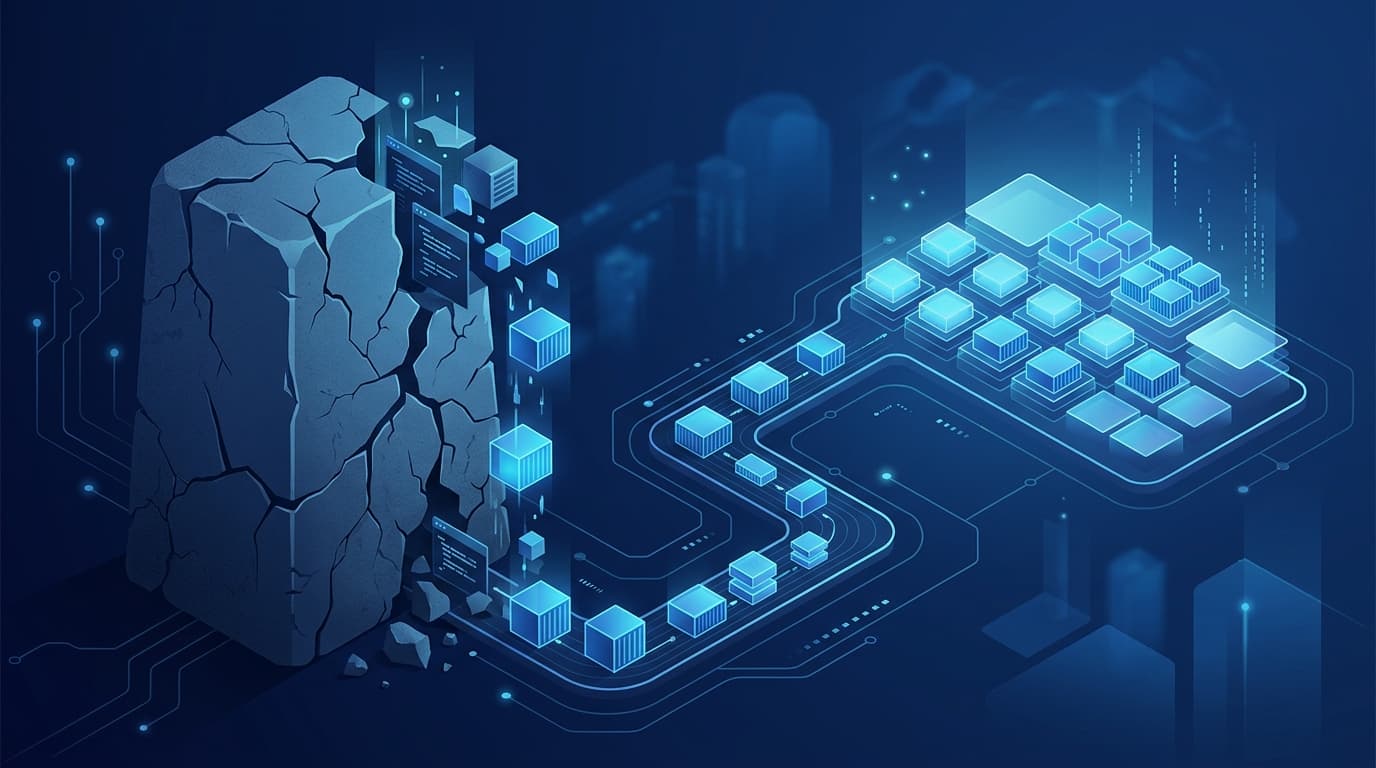
A pragmatic approach uses all four. You rehost or replatform first to get onto GKE quickly, then refactor the high-value seams over time. This is the strangler fig pattern, described by Martin Fowler, where new services gradually wrap and replace old functionality until the monolith is gone (martinfowler.com/bliki/StranglerFigApplication.html).
Phase 1: Assess the Monolith
Before writing a single Dockerfile, build an evidence base.
Inventory what you actually run
Capture the runtime, not the wiki. Document:
- Language and framework versions (and whether they are still supported).
- External dependencies: databases, message queues, file systems, third-party APIs.
- Stateful behavior: in-memory sessions, local disk writes, scheduled jobs.
- Traffic profile: request volume, peak patterns, latency SLOs.
Local disk and in-memory state are the usual blockers for containerization, because containers are ephemeral. Flag every write to local disk and every reliance on sticky sessions now.
Find the seams
Seams are natural fracture lines in the code. Look for bounded contexts: billing, authentication, catalog, notifications. Tools like dependency-cruiser (JS) or jdeps (Java) help visualize coupling.
# Example: inspect Java class dependencies to find tightly coupled packages
jdeps -verbose:class -recursive monolith.jar > deps.txt
Rank candidate services by two axes: business value and extraction difficulty. Start refactoring where value is high and coupling is low.
Phase 2: Decide the Target Architecture
Map each component to a pattern. A simple decision table keeps the team aligned.
| Component | Coupling | Value | Decision |
|---|---|---|---|
| Core order engine | High | High | Replatform now, refactor later |
| PDF report generator | Low | Medium | Refactor (extract service) |
| Legacy admin console | Low | Low | Retire |
| Session management | Medium | Infra | Replatform (externalize to Redis) |
For data, decide early whether services share the existing database or own their data. The database-per-service ideal is clean but expensive. A common interim step is a shared database with strict schema ownership per module, moving to separate stores as services stabilize.
Phase 3: Migrate to GKE
Step 1: Containerize the monolith
Start by making the monolith run in a container, unchanged. This is your safety net and your baseline.
# Multi-stage build for a Java monolith
FROM eclipse-temurin:21-jdk AS build
WORKDIR /app
COPY . .
RUN ./mvnw -q clean package -DskipTests

FROM eclipse-temurin:21-jre
WORKDIR /app
COPY --from=build /app/target/monolith.jar app.jar
# Externalize config via environment, not baked-in files
ENV JAVA_OPTS="-XX:MaxRAMPercentage=75.0"
EXPOSE 8080
ENTRYPOINT ["sh", "-c", "java $JAVA_OPTS -jar app.jar"]
Externalize configuration to environment variables or ConfigMaps. Move sessions out of memory. These replatform changes are cheap now and prevent pain later.
Step 2: Provision GKE
Use a managed cluster so you are not operating the control plane. GKE Autopilot removes most node management; Standard gives you more control.
gcloud container clusters create-auto modernization-cluster \
  --region=us-central1 \
  --release-channel=regular
Step 3: Deploy with health checks and resource limits
Kubernetes needs to know when your app is ready and healthy. Omitting probes is the most common production incident I see post-migration.
apiVersion: apps/v1
kind: Deployment
metadata:
  name: monolith
spec:
  replicas: 3
  selector:
    matchLabels:
      app: monolith
  template:
    metadata:
      labels:
        app: monolith
    spec:
      containers:
        - name: monolith
          image: gcr.io/PROJECT_ID/monolith:1.0.0
          ports:
            - containerPort: 8080
          resources:
            requests:
              cpu: "500m"
              memory: "1Gi"
            limits:
              memory: "2Gi"
          readinessProbe:
            httpGet:
              path: /healthz/ready
              port: 8080
            initialDelaySeconds: 20
            periodSeconds: 10
          livenessProbe:
            httpGet:
              path: /healthz/live
              port: 8080
            initialDelaySeconds: 40
            periodSeconds: 15
Set CPU and memory requests so the scheduler places pods correctly, and a memory limit to prevent noisy-neighbor OOM events. Be cautious with CPU limits; aggressive limits cause throttling under load.
Step 4: Apply the strangler pattern
Now extract your first service. Put an ingress or gateway in front of the monolith and route specific paths to new services. GKE Gateway API or an Ingress resource handles this.
# Route /reports to the new service, everything else to the monolith
apiVersion: networking.k8s.io/v1
kind: Ingress
metadata:
  name: strangler-ingress
spec:
  rules:
    - http:
        paths:
          - path: /reports
            pathType: Prefix
            backend:
              service:
                name: reports-service
                port:
                  number: 80
          - path: /
            pathType: Prefix
            backend:
              service:
                name: monolith
                port:
                  number: 80
Each extracted service follows the same path: build, deploy, route a slice of traffic, validate, then move the full path. Repeat until the monolith's responsibilities shrink to nothing.
This incremental decomposition from monolith to microservices is where most of the long-term value lives, but only if each step is validated in production before the next begins. Our cloud and infrastructure capabilities are built around exactly this phased approach, and the pacing varies significantly by sector, as we have seen across the industries we work with.
Step 5: Autoscale and set budgets
Horizontal Pod Autoscaler (HPA) scales pods on CPU or custom metrics.
kubectl autoscale deployment monolith \
  --cpu-percent=70 --min=3 --max=12
HPA depends on accurate resource requests. If your requests are wrong, scaling behaves unpredictably.
Phase 4: Operate and Decommission
Migration is not done at cutover. Instrument everything:
- Observability: export metrics, logs, and traces. OpenTelemetry plus Cloud Monitoring gives you request-level visibility across old and new components.
- Rollout safety: use progressive delivery (canary or blue-green) so a bad service version affects a small traffic slice first.
- Cost control: GKE cost allocation by namespace reveals which services justify their spend.
- Decommission: once a monolith path carries no traffic for a defined soak period, delete the code and the route. Dead code left "just in case" accrues security and maintenance cost.
A realistic sequencing checklist
- Containerize the monolith unchanged; deploy to GKE behind a gateway.
- Externalize config and session state (replatform).
- Add probes, resource requests, and HPA.
- Extract the lowest-coupling, highest-value service.
- Route a traffic slice; validate SLOs; complete the cutover.
- Repeat extraction; retire dead modules as you go.
- Decommission the monolith when its routes are empty.
Common Mistakes to Avoid
- Big-bang rewrites. Rewriting the whole application before any production value ships is the highest-risk path. Prefer incremental extraction.
- Ignoring data gravity. Moving compute without a data strategy creates distributed transactions and cross-service joins you cannot easily undo.
- No probes, no limits. Deploying to GKE without readiness/liveness probes and resource requests leads to cascading failures.
- Skipping observability. You cannot safely strangle a monolith you cannot measure.
A cloud modernization framework works because it converts a terrifying rewrite into a sequence of small, reversible steps. Each step ships value, each step is observable, and each step reduces the monolith's footprint until migration is complete.
FAQ
How long does a monolith to GKE migration take?
It depends on coupling and data complexity, not lines of code. A replatform to get the monolith running on GKE can take weeks. Full decomposition into microservices is typically measured in quarters, because it proceeds one validated service at a time. Sequencing by business value lets you ship benefits early rather than waiting for a complete rewrite.
Should I refactor to microservices before or after moving to GKE?
Move first, refactor second. Containerize and replatform the monolith onto GKE to establish a stable, observable baseline. Then apply the strangler fig pattern to extract services incrementally. Refactoring before migration means you carry architectural risk and infrastructure risk simultaneously.
What is the strangler fig pattern in a GKE migration?
It is an incremental replacement strategy where you place a gateway in front of the monolith and progressively route specific routes to new services on GKE. Over time, new services handle more functionality until the monolith is fully replaced and can be decommissioned. It avoids the risk of a big-bang cutover.
Do I need Kubernetes probes and resource limits from day one?
Yes. Readiness and liveness probes let GKE route traffic only to healthy pods and restart failed ones. Resource requests let the scheduler place pods correctly and are required for the Horizontal Pod Autoscaler to work. Deploying without them is the most common cause of post-migration production incidents.
How do I handle the database when splitting a monolith?
Decide ownership before extracting services. A clean target is database-per-service, but a practical interim step is a shared database with strict per-module schema ownership, migrating to separate data stores as services stabilize. Address data gravity early to avoid distributed transactions you cannot easily reverse.