What Are the Core Components of an SRE Incident Response Plan?
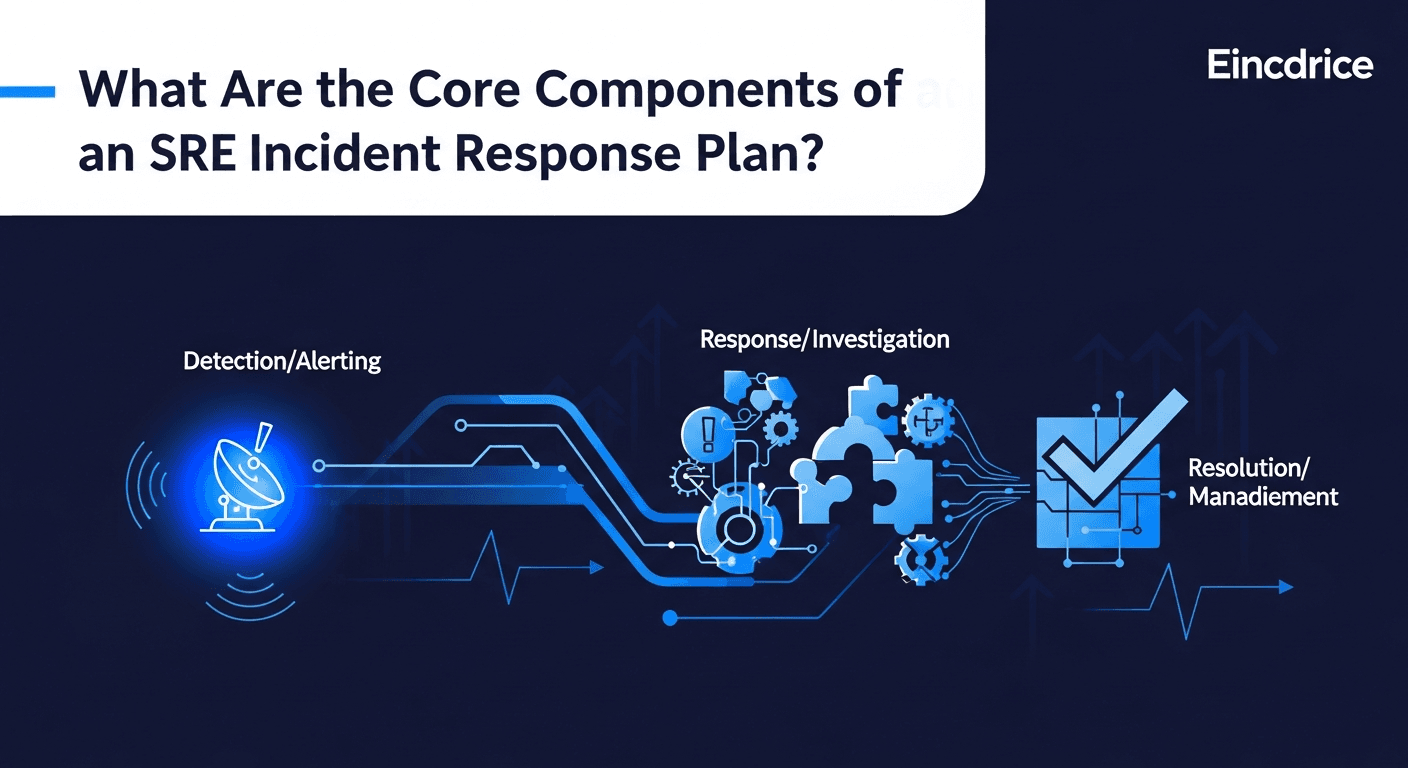
An effective SRE incident response plan has six core components: clear detection and alerting, a defined incident command structure, severity classification, structured communication channels, mitigation and recovery procedures, and a blameless post-mortem process. Together these turn chaotic outages into a repeatable workflow that limits customer impact and produces durable learning. If you operate a production service and your team improvises every time something breaks, the rest of this post gives you a concrete model to standardize on.
The goal is not to prevent every failure. Distributed systems fail, and pretending otherwise leads to brittle plans. The goal is to detect failure quickly, contain it, restore service, and feed what you learned back into the system. That is the heart of the incident management lifecycle, and it is what distinguishes mature operations teams from those who treat every outage as a surprise.
Why SRE Incident Response Needs a Plan, Not Heroics
When an incident hits without a plan, you see predictable failure patterns: nobody knows who is in charge, three engineers debug the same thing in parallel, the status page goes stale, and the eventual fix is undocumented. The next outage repeats the cycle.
Site Reliability Engineering, as defined by Google's SRE practice, frames reliability as an engineering problem governed by error budgets and service-level objectives (Google SRE Book). Incident response is the operational expression of that discipline. A documented plan does three things:
- It reduces time to detect (TTD) and time to mitigate (TTM) by removing decisions from the critical path.
- It protects responders from burnout by distributing roles instead of overloading one hero.
- It generates structured data, timelines, action items, and severity records, that you can analyze over time.
The following sections break down each component you need.
Core Component 1: Detection, Alerting, and Triage
You cannot respond to what you cannot see. The first component is observability that maps to user-facing symptoms, not just infrastructure noise.
Anchor your alerts to service-level objectives. If your SLO is 99.9% availability over 30 days, alert when the error budget burn rate threatens that target rather than on every transient blip. Multi-window, multi-burn-rate alerting is the standard approach.
# Example Prometheus alert: fast burn on a 99.9% availability SLO
- alert: HighErrorBudgetBurn
  expr: |
    (
      sum(rate(http_requests_total{status=~"5.."}[5m]))
      /
      sum(rate(http_requests_total[5m]))
    ) > (14.4 * 0.001)
  for: 2m
  labels:
    severity: page
  annotations:
    summary: "Error budget burning 14.4x faster than budget allows"
Good triage answers two questions immediately: Is this real? and How bad is it? That second question leads directly into severity.
Core Component 2: Severity Classification
Severity drives everything downstream: who gets paged, how often you communicate, and whether you wake people up at 3 a.m. Define severity levels in advance and keep them simple. A common four-tier model:
- SEV1 — Critical: Major customer-facing outage or data loss. All hands, executive notification, continuous updates.
- SEV2 — High: Significant degradation affecting many users. Dedicated incident commander, regular updates.
- SEV3 — Moderate: Partial or single-feature impact with a workaround. Handled during business hours.
- SEV4 — Low: Minor issue, minimal user impact. Tracked, not escalated.
The classification should be based on customer impact, not on how interesting the bug is to engineers. Document tie-breaker rules so responders are not debating severity while the site is down. When in doubt, declare the higher severity. You can always downgrade.
Core Component 3: Incident Command Structure
Borrowed from emergency response, the incident command model assigns roles so coordination does not collapse under pressure. The Incident Commander (IC) is not necessarily the most senior engineer or the deepest subject expert. The IC's job is to coordinate, not to fix.
Key Roles
- Incident Commander (IC): Owns the response. Makes decisions, delegates, keeps the timeline moving. Does not get heads-down in debugging.
- Operations / Subject Matter Experts (SMEs): The people actually investigating and applying fixes.
- Communications Lead: Owns external and internal updates, status page, and stakeholder messaging.
- Scribe: Records the timeline, decisions, and action items in real time.
For smaller teams, one person may wear multiple hats, but the IC and the hands-on fixer should be different people whenever an incident lasts more than a few minutes. Splitting these roles is the single highest-leverage change most teams can make.
A clear handoff protocol matters too. Long incidents span shifts. The IC role must transfer explicitly, with a verbal and written handoff so context is not lost.
Core Component 4: Communication Channels
During an incident, communication failures cause as much damage as the technical failure. Define your channels before you need them.
- A dedicated incident channel. Spin up a fresh Slack or Teams channel per incident (for example
#inc-2024-06-12-checkout). Keep all discussion there so the timeline is reconstructable. - A status page. Publish honest, timely updates to customers. Vague reassurance erodes trust faster than admitting you are investigating.
- Stakeholder updates. Leadership and support teams need a different cadence and level of detail than engineers. The Comms Lead handles this.
A simple status update template keeps messaging consistent:
[SEV2] Checkout latency elevated — INVESTIGATING
Impact: ~15% of checkout requests timing out since 14:02 UTC
Current action: Rolling back deploy v2.41.0
Next update: 14:30 UTC
Consistency reduces the cognitive load on everyone reading those updates while the fire is still burning.
Core Component 5: Mitigation, Recovery, and Uptime Management
The instinct under pressure is to find root cause. Resist it. The first priority is mitigation, restoring service, even if you do not yet understand why it broke. Root cause analysis belongs in the post-mortem.
Effective mitigation depends on having levers ready before the incident:
- Rollback paths that are tested and fast. A deploy you cannot roll back is a liability.
- Feature flags to disable a problematic code path without a full deploy.
- Traffic controls like rate limiting, load shedding, or failover to a healthy region.
- Runbooks for known failure modes, linked directly from your alerts.
This discipline is central to uptime management. Reliability is not only about preventing failures; it is about minimizing the duration and blast radius of the failures that do occur. We help teams build these mitigation levers and operating models as part of our managed services and SRE capabilities, because the right rollback and failover tooling is what makes a calm response possible.
Once service is restored, declare the incident resolved explicitly. Ambiguous endings leave responders unsure whether they can stand down.
Core Component 6: Blameless Post-Mortems
The incident is not over when the service recovers. The most valuable component of sre incident response is the post-mortem, where you convert an outage into systemic improvement.
The defining principle is blamelessness. The premise is that people act reasonably given the information and tools they had. If a junior engineer ran a destructive command, the question is not "why were they careless" but "why did the system allow a single command to cause this, and why was it so easy to run by mistake."
Post-Mortem Best Practices
A strong post-mortem document includes:
- A factual timeline with timestamps, drawn from the scribe's notes and the incident channel.
- Impact quantified: duration, affected users, error budget consumed, revenue or SLA implications if known.
- Contributing factors, plural. Real incidents rarely have a single root cause.
- Action items that are specific, assigned to an owner, and tracked to completion. Vague items like "improve monitoring" die quietly.
- What went well, so you reinforce good instincts, not just failures.
Track action item completion as seriously as you track features. A post-mortem with twelve action items and zero completed is theater. Different sectors carry different stakes here: a payment platform and a healthcare system have very different regulatory and impact profiles, which is why we tailor post-mortem rigor to the industries we work with.
Putting the Plan Together
These six components reinforce each other. Detection feeds triage; triage sets severity; severity activates the command structure and communication cadence; mitigation restores service; the post-mortem improves all of the above for next time. That feedback loop is the entire incident management lifecycle, and it only works when each part is documented and practiced.
The fastest way to build muscle memory is to run game days: simulate incidents in a controlled setting, page the on-call rotation, and rehearse the roles. Teams that practice respond measurably calmer than teams seeing the plan for the first time during a real SEV1.
Start small. Pick one severity model, name your incident commander role, create a status update template, and commit to one blameless post-mortem per significant incident. You can refine from there.
FAQ
What is the difference between an incident and an outage?
An outage is one type of incident, typically a full loss of service. An incident is any unplanned disruption or degradation that requires a response, which includes partial degradations, elevated error rates, and performance problems that have not yet caused a complete outage. Treating degradations as incidents lets you respond before they escalate.
Who should be the incident commander?
The incident commander should be whoever can coordinate effectively, not necessarily the most senior or most technical person present. The IC focuses on decision-making, delegation, and communication while subject matter experts handle the hands-on debugging. Many organizations train a rotating pool of ICs so the role is never dependent on one individual.
How soon after an incident should the post-mortem happen?
Aim to draft the post-mortem within 24 to 48 hours while details are fresh, then hold the review meeting within a week. Waiting longer means losing context and momentum on action items. The timeline should be captured during the incident itself by a dedicated scribe so reconstruction is accurate.
What metrics matter most for SRE incident response?
The most useful operational metrics are time to detect (TTD), time to mitigate (TTM), and time to resolve (TTR), alongside error budget consumption against your SLOs. These tell you whether your detection and response are improving over time. Avoid optimizing for a low incident count alone, since that can discourage teams from declaring incidents.
Do small teams need a full incident command structure?
Small teams benefit from the same roles even if one person covers several at once. The non-negotiable practice is separating the person coordinating the response from the person applying the fix once an incident runs longer than a few minutes. You can scale the formality up or down, but the underlying discipline pays off at any size.