If you are deciding between legacy modernization and a full rip-and-replace, the honest answer is that most enterprises are better served by incremental modernization, and a smaller subset genuinely need a ground-up rebuild. The deciding factors are not emotional or aesthetic. They come down to how much business logic is trapped in the current system, how often that logic changes, your tolerance for migration risk, and whether the existing platform can still meet non-functional requirements like throughput, security, and compliance. This post gives you a decision framework rather than a verdict, because the right choice depends on your constraints, not on what is fashionable.
What We Actually Mean by Legacy Modernization and Rip-and-Replace
Terminology gets muddy in these conversations, so let me be precise.
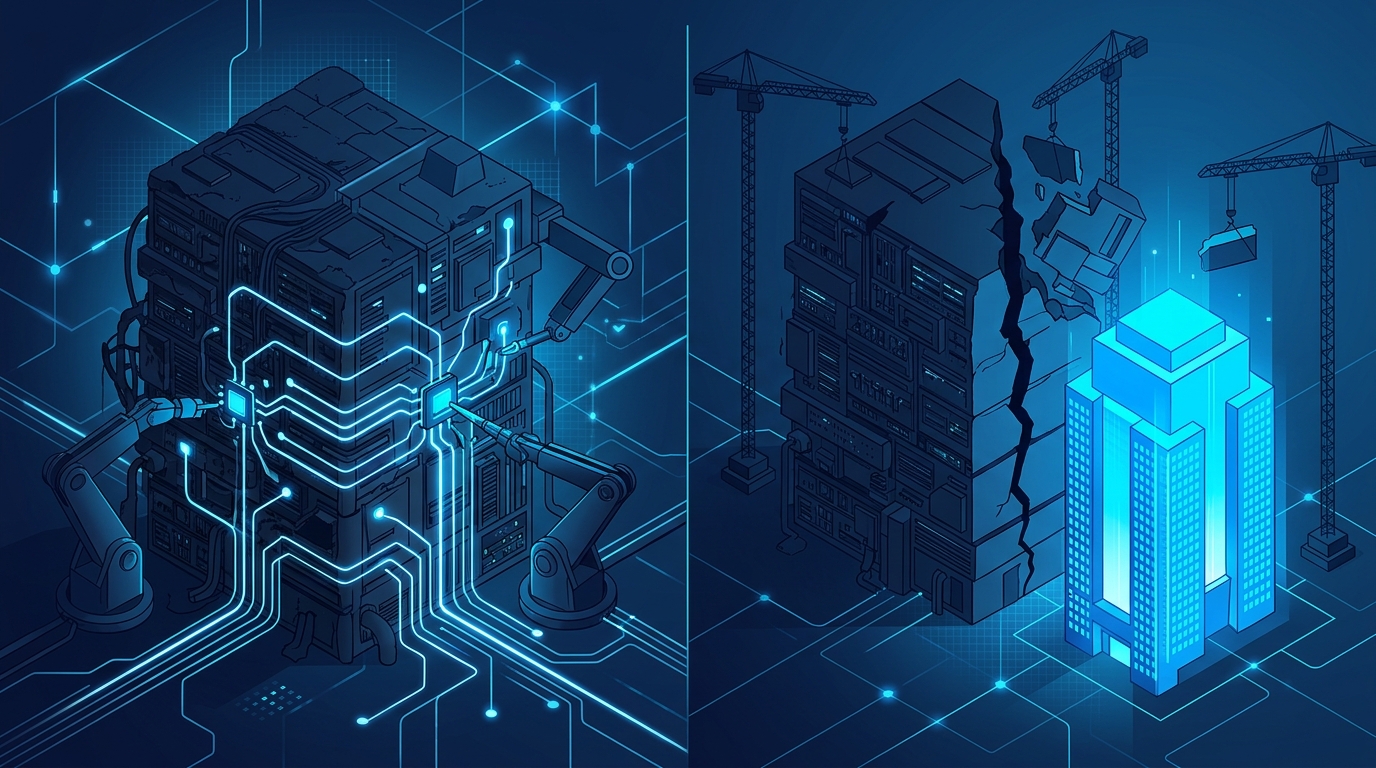
Legacy modernization is a family of techniques that preserve existing business logic and data while improving the system's architecture, runtime, interfaces, or deployment model. It is evolutionary. You keep the system running while you change it underneath.
Rip-and-replace means decommissioning the existing system and standing up a new one, often on a different stack, data model, and vendor footprint. It is revolutionary. You run the old and new in parallel, cut over, and retire the original.
The reason this distinction matters is cost of error. Modernization fails incrementally and recoverably. Rip-and-replace tends to fail catastrophically, usually at cutover, when years of undocumented edge cases surface at once.
The Modernization Spectrum
Gartner's widely cited "5 Rs" (rehost, replatform, refactor, rearchitect, rebuild) are a useful shorthand, later expanded to seven in various cloud migration frameworks. In practice, I group the realistic options like this:
- Rehost ("lift and shift"): Move the workload to new infrastructure with minimal code change. Fastest, lowest risk, smallest payoff.
- Replatform: Rehost plus targeted changes, such as swapping a self-managed database for a managed one.
- Refactor: Restructure code without changing external behavior. Improves maintainability and testability.
- Rearchitect: Change the system's structure, for example decomposing a monolith into services.
- Rebuild / Replace: Build new or buy a package. This is the rip-and-replace end of the spectrum.
Most real programs combine several of these. A single mainframe estate might rehost the stable batch jobs, rearchitect the customer-facing layer, and replace a commodity reporting module with SaaS.
When Legacy Modernization Is the Right Call
Choose incremental modernization when the following are true:
- The business logic is valuable and poorly documented. If the "spec" lives in the code and the heads of a few long-tenured engineers, rewriting it is an exercise in archaeology. Every rewrite silently drops behavior that someone, somewhere depends on.
- The domain is stable but the technology is aging. A payroll engine whose rules change twice a year does not need a new brain. It needs a new body: supported runtimes, patched dependencies, observable interfaces.
- Downtime is expensive and continuous. Systems that cannot tolerate a hard cutover favor strangler-style migration, where you redirect traffic feature by feature.
- Budget and risk appetite are constrained. Modernization lets you deliver value in increments and stop when the marginal return drops.
The Strangler Fig Pattern
Martin Fowler popularized the Strangler Fig pattern, named after the vine that grows around a tree and gradually replaces it. You place a routing layer in front of the legacy system and incrementally move functionality behind it.
          ┌─────────────────────────┐
Client ──▶│   Routing / Facade      │
          └───────────┬─────────────┘
              ┌────────┴─────────┐
              ▼                  ▼
      ┌──────────────┐   ┌──────────────┐
      │  Legacy app  │   │ New service  │
      │ (shrinking)  │   │ (growing)    │
      └──────────────┘   └──────────────┘
A minimal routing rule at the edge might look like this:
# Route new, migrated endpoints to the new service.
# Everything else falls through to the legacy monolith.
location /api/v2/billing/ {
    proxy_pass http://new-billing-service;
}

location / {
    proxy_pass http://legacy-monolith;
}
The advantage is that each migrated slice is independently testable and reversible. If the new billing service misbehaves, you flip one proxy rule back. There is no "big bang" weekend where the whole business is betting on a cutover script.
When Rip-and-Replace Is Justified
Full replacement is the correct decision in specific situations. Do not default to it, but do not avoid it dogmatically either.
- The platform is a genuine dead end. Unsupported runtimes with security vulnerabilities, hardware that is out of warranty and unobtainable, or a vendor that has exited the market.
- A commodity package now does the job better. If your custom-built CRM, HR system, or ticketing tool no longer offers competitive differentiation, buying mature SaaS may beat maintaining code you never should have owned.
- The data model is the problem. When the core schema encodes assumptions that are now wrong, refactoring around it costs more than starting clean. Logic you can wrap. A fundamentally broken data model you often cannot.
- Regulatory or audit requirements cannot be met. Some older systems simply cannot produce the logging, access control, or data residency guarantees that new regulations demand.
The critical caveat: rip-and-replace is a parallel-run exercise, not a switch-flip. Plan for months of running both systems, reconciling outputs, and migrating data in waves. The projects that fail are the ones that treat replacement as a procurement event rather than an engineering program.
A Decision Framework You Can Actually Use
Score the current system across these dimensions. I use a simple 1-to-5 scale per axis.
| Dimension | Favors Modernization | Favors Replacement |
|---|---|---|
| Business logic complexity | High and undocumented | Low or commodity |
| Rate of domain change | Low to moderate | N/A (buying package) |
| Data model health | Sound, extensible | Fundamentally flawed |
| Platform viability | Supportable | Dead end |
| Downtime tolerance | Low | Higher / planned |
| Differentiation | Core to the business | Commodity |
A practical reading: if business logic is complex and the data model is sound, modernize, even if the platform is dated. If the logic is commodity and a mature package exists, replacement deserves serious evaluation. Mixed scores point to a hybrid, which is the most common real-world answer.
Do the Boring Prerequisites First
Regardless of direction, these steps de-risk everything that follows:
- Build a characterization test suite. Capture the current system's observable behavior as executable tests before you change anything. This is your safety net and your migration acceptance criteria.
- Instrument before you migrate. You cannot migrate traffic you cannot see. Add request logging and metrics at the boundary.
- Catalog integrations. Every downstream consumer is a cutover dependency. Surprises here cause the worst failures.
- Classify the data. Residency, retention, and sensitivity drive both architecture and compliance.
If you want help running this assessment with a repeatable method, our IT strategy and advisory capabilities are built around exactly this kind of evidence-based evaluation. For sector-specific constraints such as regulated workloads, our industry practice areas cover the compliance and operational realities that shape the decision.
Cost Comparison: The Numbers That Matter
Avoid headline price tags and compare total cost of ownership over a realistic horizon, typically three to five years. Account for:
- Build or migration cost, including parallel-run infrastructure.
- Opportunity cost of engineers tied up in the program.
- Risk-adjusted downtime and the probability of cutover failure.
- Ongoing run cost, including licensing, support, and the talent market for the chosen stack.
A rehost looks cheap until you add the run cost of an architecture that still resists change. A rip-and-replace looks expensive until you factor in the compounding cost of maintaining a dead-end platform. The right comparison is lifecycle cost against delivered capability, not upfront price.
My Recommendation
Default to incremental application modernization using the Strangler Fig pattern, and reserve rip-and-replace for the specific cases above: dead-end platforms, broken data models, commodity functionality better served by a package, or compliance gaps you cannot close in place. Whatever you choose, treat it as an engineering program with tests, instrumentation, and a reversible path, not a one-time purchase. The strategy that fits your enterprise is the one your evidence supports, not the one the loudest vendor is selling.
FAQ
Is legacy modernization always cheaper than rip-and-replace?
Not always, but it usually carries lower risk. Modernization spreads cost over time and delivers value incrementally, so you can stop or adjust. Rip-and-replace can be cheaper in total cost of ownership when the existing platform is a dead end or the function is a commodity better served by a package. Compare lifecycle cost, not upfront price.
What is the Strangler Fig pattern?
It is a migration approach where you place a routing layer in front of a legacy system and incrementally move functionality to new services behind it. Each slice is independently testable and reversible, which avoids a high-risk "big bang" cutover. The legacy system shrinks as the new one grows until it can be retired.
How do I know if my data model requires a full rebuild?
If the core schema encodes assumptions that are now incorrect, and most new requirements force awkward workarounds or denormalization, the data model is likely the constraint. Business logic can often be wrapped and preserved. A fundamentally broken data model is harder to refactor around than to replace.
Can I combine both strategies?
Yes, and most enterprises do. A typical program rehosts stable components, rearchitects the parts that change often, and replaces commodity modules with SaaS. Hybrid approaches let you match each component to the strategy its characteristics warrant.
What should I do before starting either approach?
Build a characterization test suite that captures current behavior, instrument the system boundary so you can observe and migrate traffic safely, catalog every integration, and classify your data for residency and compliance. These prerequisites de-risk both modernization and replacement.