Legacy Modernization vs. Rip-and-Replace: Which Strategy Fits Your Enterprise Architecture?
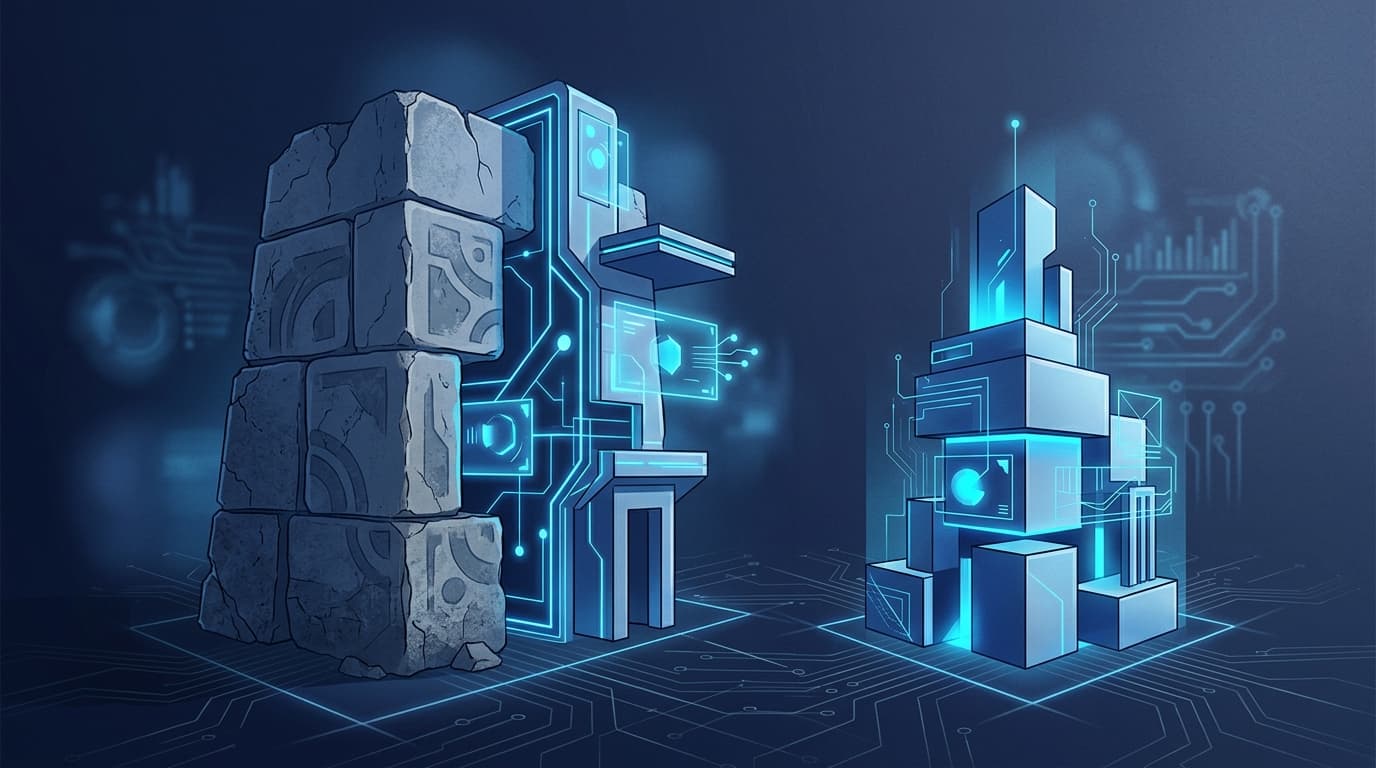
If you are weighing legacy modernization against a full rip-and-replace, the honest answer is this: for most enterprises, incremental modernization is the lower-risk, higher-return default, and rip-and-replace is justified only when the existing system cannot meet your business requirements no matter how much you invest in it. The decision is rarely about technology preference. It is about risk tolerance, the cost of downtime, the clarity of your domain knowledge, and whether the old system still encodes rules nobody has documented.
Below I lay out how I evaluate these two strategies, the trade-offs that actually matter, and a decision framework you can apply to your own estate.
What We Mean by Legacy Modernization and Rip-and-Replace
These terms get used loosely, so let me define them precisely before we compare.
Legacy modernization is a family of techniques that improve an existing system in place, or migrate it in controlled increments, while keeping it running. Gartner's well-known "7 Rs" framework describes the common paths: Rehost, Replatform, Refactor, Rearchitect, Rebuild, Replace, and Retire. Most modernization work lives in the middle of that spectrum, where you preserve business logic but change its runtime, structure, or deployment model.
Rip-and-replace is exactly what it sounds like: you decommission the old system and stand up a new one, often built on a different stack or purchased as a commercial product. The cutover may be phased, but the end state is a clean break from the legacy codebase.
The key distinction is not speed. It is continuity of the existing asset. Modernization treats the legacy system as something to evolve. Rip-and-replace treats it as something to retire.
The Case for Legacy Modernization
Incremental modernization wins most often because it de-risks the one thing that sinks large rewrites: the gap between what you think the system does and what it actually does.
You keep institutional logic you cannot fully see
A twenty-year-old order management system contains thousands of edge cases: tax rules for a jurisdiction you entered once in 2011, a retry path for a partner API that no longer exists, a discount rule a VP added by hand. This is tacit business logic. It is rarely documented and often lives only in the code. Modernization lets you carry it forward and retire it deliberately, rather than rediscovering it through production incidents after a cutover.
You can ship value before the project "finishes"
A multi-year rewrite delivers nothing until it ships. Modernization delivers in slices. The strangler fig pattern, named by Martin Fowler, is the canonical approach: you place a routing layer in front of the legacy system and incrementally redirect traffic to new services as you build them.
          +-------------------+
Client -> |  Routing / Proxy  |
          +---------+---------+
                    |
        +-----------+-----------+
        |                       |
   New Service            Legacy Monolith
  (orders, v2)          (everything else)
Each migrated capability is live, observable, and reversible. If a new service misbehaves, you route back to the legacy path. That rollback safety is the single biggest reason modernization outperforms big-bang rewrites on risk.
The incremental menu, from cheapest to deepest
- Rehost (lift-and-shift): move the workload to new infrastructure with minimal code change. Fast, low risk, limited upside.
- Replatform: adjust for the target environment, for example swapping a self-managed database for a managed service.
- Refactor: restructure code for maintainability without changing behavior.
- Rearchitect: change the architecture itself, such as decomposing a monolith into services.
- Rebuild: rewrite a bounded component while preserving its contract.
Most real programs blend these. You might rehost first to exit a data center, then rearchitect the highest-churn modules.
The Case for Rip-and-Replace
Modernization is not always the right call. There are conditions where continuing to invest in the old system is throwing good money after bad.
When the platform itself is the constraint
If the system runs on an unsupported runtime, a database with no upgrade path, or a language with no viable hiring pool, you are paying a growing tax every year. At some point the cost and risk of keeping it alive exceed the cost of replacement. A mainframe application with a shrinking pool of COBOL engineers and no vendor support is a textbook example.
When a commercial product covers the domain
If your custom system solves a now-commoditized problem, for example payroll, CRM, or basic ticketing, a mature SaaS or packaged product may deliver more capability than you can justify building. Here "replace" is really "buy," and the comparison shifts to integration cost and configuration flexibility.
When the data model is fundamentally wrong
Some systems encode a data model that no longer matches the business. If every new feature requires fighting the schema, modernization just preserves the problem in a nicer wrapper. A clean rebuild with a correct domain model can be the cheaper long-term path.
The honest risk with rip-and-replace is the second-system effect, Fred Brooks's warning that teams building a replacement tend to over-engineer it with every feature they wished the first system had. Replacements fail when scope balloons and the cutover keeps slipping.
A Decision Framework You Can Apply
I use a small set of questions to steer the strategy. Score each honestly.
- How well is the current behavior understood? Low understanding favors modernization, which lets you discover behavior incrementally.
- Is the blocker the platform or the design? A platform problem favors rehost or replatform. A design problem favors rearchitect or rebuild.
- What is the cost of a bad cutover? High blast radius, for example payments or clinical systems, favors incremental migration with rollback.
- Does a credible product already exist? If yes, evaluate buy-versus-build before any custom rebuild.
- Can you fund a multi-year effort with no interim delivery? If no, big-bang replacement is financially fragile.
A simple way to reason about it:
if platform_unsupported and no_upgrade_path:
    consider_replace_or_rebuild()
elif commercial_product_fits_domain:
    evaluate_buy()
elif business_logic_poorly_understood or cutover_risk_high:
    prefer_incremental_modernization()   # strangler fig
else:
    choose_based_on_total_cost_of_ownership()
Treat this as a conversation starter, not an oracle. Most estates need a portfolio decision: retire a few apps, modernize the core, and replace one or two commodity systems.
Avoiding the Common Failure Modes
Whichever path you choose, the same mistakes recur.
- No seam, no safety. Both strategies need a routing or integration layer so you can shift traffic and roll back. Build it first.
- Migrating without observability. You cannot verify a migration you cannot measure. Add logging, tracing, and comparison tooling before you move traffic.
- Treating data as an afterthought. Data migration and reconciliation are usually the hardest part. Plan for dual-writes, backfills, and validation.
- Skipping the retirement decision. Some apps should simply be retired. Running an inventory and tagging each application with its target disposition prevents effort going to systems nobody needs.
If you want help running that assessment and choosing an application modernization strategy that fits your constraints, our engineering and advisory capabilities cover portfolio assessment through delivery. For sector-specific constraints, such as regulated data handling, see how we approach work across different industries we serve.
Bringing It Together
The comparison is not modernization versus rip-and-replace in the abstract. It is a per-application judgment driven by platform viability, domain understanding, cutover risk, and the availability of a credible product alternative. In my experience, incremental legacy modernization should be the default because it preserves institutional logic and keeps rollback on the table. Rip-and-replace earns its place when the platform or the data model is the real constraint, or when the market already sells what you would otherwise build.
Make the decision at the application level, protect every migration with a seam and observability, and commit to retiring what no longer serves the business.
FAQ
Is legacy modernization always cheaper than rip-and-replace?
Not always, but it usually carries lower risk and delivers value sooner. Modernization spreads cost over time and keeps the system running, while rip-and-replace concentrates risk at cutover. The exception is when the platform is unsupported or a commercial product fits the domain, in which case replacement can have a lower total cost of ownership.
What is the strangler fig pattern?
It is an incremental migration approach where you place a routing layer in front of a legacy system and redirect functionality to new services one capability at a time. The legacy system shrinks until it can be retired. Its main benefit is reversibility: if a new service fails, you route traffic back to the old path.
How do I decide which applications to modernize versus replace?
Run an application inventory and tag each system with a target disposition using a framework like the 7 Rs. Weigh platform viability, how well the business logic is understood, cutover risk, and whether a credible product alternative exists. Most enterprises end up with a mix across the portfolio rather than a single strategy.
What is the biggest risk in a rip-and-replace project?
Scope expansion, often called the second-system effect, where the replacement accumulates every wished-for feature and the cutover keeps slipping. Combined with hidden business logic in the old system, this is the most common cause of failed replacements. Tight scope and thorough behavior discovery mitigate it.