How Generative AI Can Accelerate Root Cause Analysis for Faster SRE Incident Response

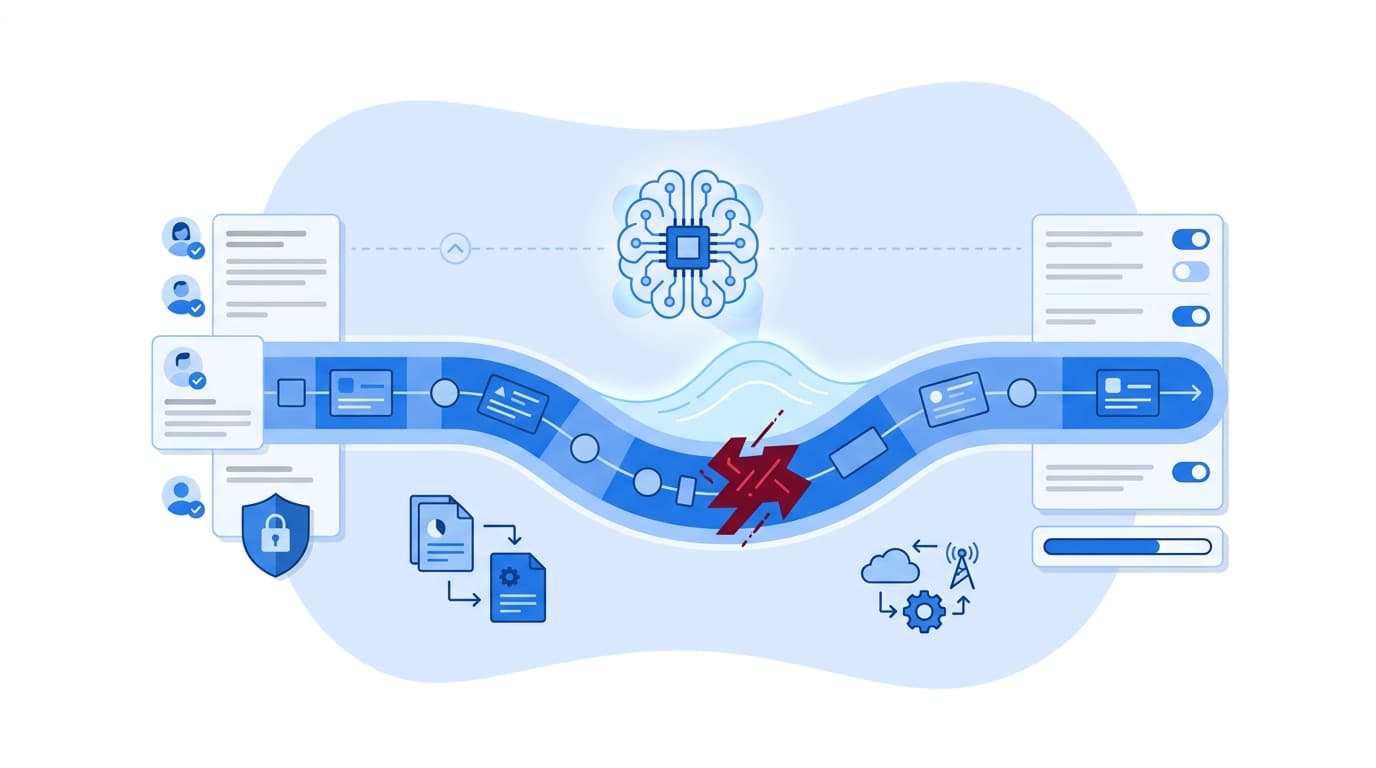
Generative AI speeds up root cause analysis by doing the slow, manual parts of an investigation for you. It gathers the relevant telemetry, correlates recent changes with symptoms, summarizes noisy timelines, and proposes ranked hypotheses that an on-call engineer can confirm or reject. A well-designed Generative AI SRE workflow does not replace the responder. It shortens the time between "the pager went off" and "we know what broke," which is usually the largest part of mean time to resolution (MTTR). The rest of this post covers how to build that workflow, where it helps, where it fails, and how to keep it trustworthy.
Why Root Cause Analysis Is the Bottleneck
If you have been on call for a distributed system, you know the pattern. Detection is fast because alerting is automated. Mitigation is often fast once you know what to roll back or fail over. The middle stretch is the problem: figuring out why things broke.
During that stretch, responders typically:
- Open five to ten dashboards across metrics, logs, and traces
- Scroll deployment history and feature flag changes
- Search chat channels and old postmortems for "have we seen this before?"
- Hold a mental model of service dependencies that may be out of date
- Explain context to each new person who joins the incident bridge
None of this is intellectually hard. Most of it is retrieval and correlation under time pressure, and humans are worst at it at 3 a.m. The Google SRE book's chapters on effective troubleshooting and emergency response describe this hypothesize-and-test loop in detail, and they note that the investigation phase is where experience gaps between responders show most clearly (Google, Site Reliability Engineering, "Effective Troubleshooting").
Large language models are well suited to retrieval, summarization, and pattern-matching across text. That is why the investigation phase is where we think generative AI earns its place.
Where Generative AI SRE Workflows Actually Help
We find it useful to break AI root cause analysis into four distinct jobs. Each has different reliability characteristics, so treat them separately.
1. Context assembly
The model, or more precisely the pipeline around it, pulls together everything relevant to the alert: recent deploys, config changes, error log samples, trace exemplars, and the health of upstream and downstream dependencies. This is the highest-value, lowest-risk job, because the output is raw evidence that a human can verify directly.
2. Timeline summarization
Incidents generate hundreds of log lines, alerts, and chat messages. A model can compress these into a readable timeline: "14:02 deploy of checkout-api v2.41; 14:04 p99 latency on payments rises; 14:05 connection pool exhaustion errors begin." This helps the responder and anyone who joins the bridge later.
3. Hypothesis generation
Given the assembled context, the model proposes likely causes ranked by supporting evidence. This is where the most care is needed. A hypothesis is a suggestion, not a diagnosis.
4. Knowledge retrieval
Retrieval-augmented generation (RAG) lets the model search past postmortems and runbooks for similar failure signatures and cite them (Lewis et al., 2020, "Retrieval-Augmented Generation for Knowledge-Intensive NLP Tasks"). This turns your postmortem archive from a write-only document store into something responders actually use mid-incident.
Building the Workflow: A Step-by-Step Approach
Here is the sequence we recommend for teams adding generative AI to incident response. Each step is independently useful, so you can stop at any point and still have gained something.
Step 1: Standardize your telemetry
AI is only as good as the context it receives. If your services emit inconsistent log formats and lack trace context, start there. Adopting OpenTelemetry semantic conventions gives you consistent attribute names (service.name, deployment.environment, http.response.status_code) that both humans and models can rely on.
Step 2: Build a deterministic context bundle
Do not let the model query your observability stack freely at first. Instead, write ordinary code that assembles a bounded, structured context bundle when an alert fires. This keeps behavior predictable and auditable.
from datetime import timedelta

def build_context_bundle(alert, window=timedelta(minutes=30)):
    start = alert.fired_at - window
    service = alert.labels["service"]

    return {
        "alert": {
            "name": alert.name,
            "service": service,
            "fired_at": alert.fired_at.isoformat(),
            "summary": alert.annotations.get("summary"),
        },
        "recent_changes": deploys.list(service=service, since=start)
                          + flags.changes(service=service, since=start),
        "dependencies": topology.neighbors(service, depth=1),
        "error_samples": logs.query(
            service=service, level="error", since=start, limit=50,
            dedupe_by="message_template",
        ),
        "slow_traces": traces.exemplars(service=service, since=start, limit=5),
        "golden_signals": metrics.golden_signals(service, since=start),
        "similar_incidents": postmortems.search_similar(alert, top_k=3),
    }
Note the deduplication and limits. Feeding a model thousands of near-identical log lines wastes context and can degrade answer quality. Research on long-context models has shown that relevant information buried in the middle of a long prompt is used less reliably (Liu et al., 2023, "Lost in the Middle"). Smaller, curated bundles tend to work better.
Step 3: Prompt for evidence, not conclusions
Structure the prompt so the model must cite the specific evidence behind each claim, and must say when evidence is insufficient.
You are assisting an on-call SRE. Using ONLY the context provided:

1. Write a timeline of events in UTC, one line per event.
2. List up to 3 hypotheses for the root cause, ranked by evidence strength.
   For each: cite the exact context fields that support it, and name
   one check the responder can run to confirm or rule it out.
3. If the context does not support any hypothesis, say so explicitly.

Do not suggest remediation commands. Do not speculate beyond the data.

CONTEXT:
{context_bundle_json}
Asking for a falsifying check with each hypothesis is the single most useful pattern we have found. It turns model output into an actionable investigation plan rather than a confident-sounding guess.
Step 4: Deliver output where responders already work
Post the summary into the incident channel or attach it to the incident ticket automatically. If responders have to open a separate tool, adoption drops. Keep the raw context bundle linked so anyone can check the model's citations.
Step 5: Close the loop with postmortems
After resolution, record whether the AI's top hypothesis was correct, partially correct, or wrong. Feed confirmed root causes back into the postmortem index. Over time, this improves retrieval quality and gives you real data on whether the system helps.
Guardrails That Keep It Trustworthy
Incident response is high-stakes, and a confident wrong answer can extend an outage. We recommend these guardrails as a baseline:
- Read-only by default. The assistant reads telemetry. It does not execute rollbacks, restarts, or config changes. If you later add action capabilities, gate them behind explicit human approval.
- Data redaction. Strip secrets, tokens, and personal data from log samples before they reach any model, especially a third-party hosted one.
- Citation enforcement. Reject or flag output whose claims do not map to fields in the context bundle.
- Clear labeling. Mark AI-generated content visibly so nobody mistakes a hypothesis for a confirmed finding.
- Model and prompt versioning. Log which model version and prompt template produced each output, so you can audit behavior after the fact.
A simple policy file makes these rules explicit and reviewable:
incident_assistant:
  mode: read_only
  allowed_sources: [metrics, logs, traces, deploys, flags, postmortems]
  redaction:
    patterns: [api_key, bearer_token, email, credit_card]
  output:
    require_citations: true
    label: "AI-generated hypothesis. Verify before acting."
  actions:
    enabled: false
For a broader governance frame, the NIST AI Risk Management Framework offers useful vocabulary for documenting risks, controls, and accountability.
Measuring Whether It Shortens MTTR
Avoid declaring victory on anecdotes. To evaluate incident response acceleration honestly, track:
- Time to first credible hypothesis: from alert to the moment responders agree on a working theory
- Hypothesis accuracy: how often the top suggestion matched the confirmed root cause
- Time to restore service: the DORA metric for recovery speed (DORA research program)
- Responder feedback: a one-click "useful / not useful" rating on each summary
Compare incidents handled with and without the assistant over a meaningful period, and segment by incident type. You will likely find it helps a lot with change-induced failures and less with novel, multi-factor ones. That is useful knowledge in itself, because it tells you where to invest next.
Getting Started Without Overcommitting
You do not need a large platform initiative to start. A practical first milestone is Steps 1 through 4 for a single critical service, running in "shadow mode" where summaries are posted but responders are not expected to rely on them. After a few weeks of incidents, review accuracy with the team and decide whether to expand.
If you want help designing observability foundations, on-call practices, or AI-assisted operations, you can explore our managed services and SRE capabilities. Reliability requirements also vary a lot by domain, so it is worth reviewing how these patterns apply in regulated and high-availability industries before you roll them out broadly.
FAQ
Can generative AI fully automate root cause analysis?
Not reliably today, and we would not recommend trying. Models are strong at gathering and summarizing evidence and proposing hypotheses, but they can be confidently wrong. The safest design keeps a human responsible for confirming root cause and approving any remediation.
What data does an AI root cause analysis system need?
At minimum: structured logs, metrics for the golden signals (latency, traffic, errors, saturation), distributed traces, deployment and feature flag history, and a service dependency map. Past postmortems significantly improve the quality of hypotheses through retrieval.
Is it safe to send production logs to a hosted LLM?
Only after redaction and a review of your provider's data handling terms. Strip credentials and personal data before logs leave your environment. Some teams choose self-hosted models for sensitive workloads to keep telemetry inside their own boundary.
How does generative AI help achieve faster MTTR in SRE?
It compresses the investigation phase. Instead of manually opening dashboards and searching history, responders start with a curated evidence bundle, a timeline, and ranked hypotheses with specific checks to run. Measure time to first credible hypothesis to confirm the effect in your own environment.
Where should a team start with Generative AI SRE?
Start with telemetry consistency and a deterministic context bundle for one critical service. Run it in shadow mode, track hypothesis accuracy, and expand only once responders trust the output.